
Are you struggling to get your website noticed on the world’s most popular search engine? With millions of sites competing for attention, it can be tough to stand out from the crowd.
We understand that SEO is crucial for businesses to establish a strong online presence, especially in a competitive digital marketplace like Qatar. Our goal is to help you drive more qualified traffic to your site and increase your visibility in search results.
By implementing proven SEO strategies, you can significantly improve your online presence and attract the right users who are likely to convert into customers.
Key Takeaways
- Understand the fundamentals of search engine optimization (SEO) to establish a strong online presence.
- Implement technical and content-based approaches to improve your website’s visibility.
- Attract the right users who are likely to convert into customers.
- Stay ahead of the competition in Qatar’s competitive digital marketplace.
- Drive more qualified traffic to your site and increase your online presence.
Understanding How Google Search Works
Google’s search engine operates through a multi-step process that involves crawling, indexing, and ranking web pages. This process is fundamental to understanding how to optimize your website for better visibility.
The Crawling and Indexing Process
Google uses sophisticated crawlers (also known as “spiders”) to systematically explore the web, following links from page to page and site to site to discover new content. Once Google discovers your pages, they’re processed and added to Google’s massive index—essentially a database of all the content Google has found on the web. As stated on Google’s official documentation, “you usually don’t need to do anything except publish your site on the web.” In fact, most sites listed in Google’s results are found and added automatically as we crawl the web.
Google’s Ranking Factors
Google evaluates hundreds of signals, including content quality, user experience metrics, site authority, and technical performance, to determine where your pages appear in search results. For more detailed information on Google’s ranking factors, you can refer to resources like Backlinko’s guide on Google ranking factors. Recent algorithm updates have increasingly emphasized page experience factors like Core Web Vitals alongside traditional content-based ranking factors. Understanding these elements gives you a strategic advantage in optimizing your website for better rankings.
Technical SEO Fundamentals
Technical SEO fundamentals are the backbone of any successful website ranking strategy, ensuring that search engines can crawl, understand, and index your site effectively. We will examine the critical aspects that form the foundation of a well-optimized website.
Site Speed Optimization
Site speed optimization is no longer optional—it’s a crucial ranking factor that directly impacts both user experience and search visibility. To improve your site’s loading times, consider techniques such as image compression, code minification, and leveraging browser caching. Utilize website speed optimization tools to identify areas for improvement.
Mobile-Friendly Design
With Google’s mobile-first indexing, having a mobile-friendly design is essential. This means your site’s mobile version should be just as robust and user-friendly as its desktop counterpart, ensuring a seamless experience across all devices.
Core Web Vitals
Core Web Vitals are Google’s metrics for measuring page experience, focusing on Largest Contentful Paint (LCP), First Input Delay (FID), and Cumulative Layout Shift (CLS). Understanding and improving these metrics is crucial for meeting Google’s standards and enhancing user experience.
By focusing on these technical SEO fundamentals, you can create a solid foundation for your website’s ranking strategy, ensuring that search engines can properly crawl, understand, and index your site. This not only improves your site’s visibility but also enhances the overall user experience, driving engagement and conversion.
Keyword Research and Implementation
Keyword research and implementation are pivotal elements in enhancing your online presence and driving relevant traffic to your site. To maximize your SEO efforts, it’s essential to understand how to effectively conduct keyword research and integrate the findings into your content strategy.
Finding the Right Keywords for Your Business
Finding the right keywords for your business involves understanding your target audience, analyzing your competitors, and identifying terms with the optimal balance of search volume and competition. We guide you through the process of conducting thorough keyword research—the foundation of any successful SEO strategy.
To discover valuable keywords that can drive qualified traffic to your Qatar-based business, we’ll introduce effective keyword research tools and methodologies. For more information on how to effectively add SEO keywords to your website, you can learn how to add SEO keywords to your website.
Understanding Search Intent
Understanding search intent is crucial—it’s not just about what keywords people use, but why they’re searching and what they hope to find. We’ll explain the four main types of search intent (informational, navigational, commercial, and transactional) and how to align your content with each type.
Long-Tail Keywords Strategy
A long-tail keywords strategy focuses on longer, more specific keyword phrases that typically have lower search volume but higher conversion potential. By implementing a strategic mix of head terms and long-tail keywords, you can create a comprehensive approach to capturing search traffic at various stages of the customer journey.
Creating High-Quality Content That Ranks
High-quality content is the backbone of any successful SEO strategy, driving both user engagement and search engine rankings. Creating content that people find compelling and useful will likely influence your website’s presence in search results more than any other factor.
To create such content, it’s essential to understand the critical elements that satisfy both search engines and human readers. These elements include content length and depth, the incorporation of LSI keywords, and content structure and readability.
Content Length and Depth
Content length and depth have become increasingly important ranking factors, with comprehensive, in-depth content typically outperforming shorter pieces. The optimal content length can vary depending on the type of page and the user’s search intent.
For instance, a detailed guide or tutorial may require more words to cover the topic comprehensively, while a news article might be effectively communicated in fewer words. The key is to provide meaningful depth without unnecessary fluff, ensuring that the content adds genuine value to the reader.
| Content Type | Recommended Word Count | Key Characteristics |
|---|---|---|
| Blog Posts | 1000-1500 words | In-depth analysis, detailed explanations |
| News Articles | 500-800 words | Concise, factual, timely |
| Product Descriptions | 200-500 words | Clear, compelling, focused on benefits |
Incorporating LSI Keywords
Incorporating LSI (Latent Semantic Indexing) keywords—terms semantically related to your main keyword—helps Google understand your content’s context and relevance. This technique enhances your topical authority without resorting to keyword stuffing.
For example, if your main keyword is “SEO strategies,” LSI keywords might include “search engine optimization,” “keyword research,” and “link building.” Naturally integrating these terms into your content can improve its visibility and ranking.
“The more relevant content you create, the more you’ll be able to attract links and shares, which are crucial for SEO.”
Content Structure and Readability
Content structure and readability directly impact both user engagement metrics and search engine understanding of your content. Organizing content with clear headings, subheadings, bullet points, and short paragraphs improves readability and enhances the user experience.
We recommend using a clear and concise writing style, breaking up long content into manageable sections, and providing headings to help users navigate your pages. This approach not only satisfies Google’s quality standards but also provides genuine value to your readers.
For more insights on creating effective SEO strategies, visit our page on SEO website design solutions for digital success.

On-Page SEO Optimization Techniques
To rank higher in search results, it’s essential to master on-page SEO optimization techniques that directly influence how search engines interpret and rank your web pages. On-page SEO involves optimizing individual web pages to improve their search engine rankings and drive more targeted traffic to your site.
Title Tags and Meta Descriptions
Title tags are one of the most critical on-page SEO elements, serving as the clickable headline in search results and significantly impacting click-through rates. We recommend creating compelling title tags that incorporate your target keywords while encouraging clicks from searchers. For expert tips on optimizing your website title, visit our guide on optimizing website titles.
Meta descriptions, while not direct ranking factors, function as “organic ad copy” that can dramatically improve your click-through rate from search results. Craft meta descriptions that accurately summarize the content of your page and entice users to click through.
- Keep title tags concise, ideally under 60 characters.
- Ensure meta descriptions are between 150-160 characters.
- Use target keywords in both title tags and meta descriptions.
Header Tags and Content Organization
Header tags (H1, H2, H3) create a hierarchical structure that helps both users and search engines understand your content organization and main topics. Implementing a logical header structure that incorporates relevant keywords while maintaining natural readability is crucial.
Best practices include:
- Using a single H1 tag per page for the main title.
- Organizing content with H2 and H3 tags.
- Incorporating target keywords in header tags where relevant.
URL Structure and Internal Linking
URL structure and internal linking work together to establish site architecture and help Google understand the relationships between your pages. Creating SEO-friendly URLs and implementing strategic internal linking can distribute page authority and guide users through your site.
To optimize your URL structure:
- Keep URLs concise and descriptive.
- Include target keywords where appropriate.
- Avoid using unnecessary characters or numbers.

By mastering these on-page SEO optimization techniques, you can significantly improve your website’s search engine ranking and drive more qualified leads to your site.
Improving Website Ranking on Google Through Backlinks
Building high-quality backlinks is a proven strategy for enhancing your website’s ranking on Google. Backlinks, which are links from other websites to your website, are considered a vote of confidence by search engines. They play a crucial role in determining your website’s authority and credibility online.

Quality vs. Quantity in Link Building
When it comes to link building, the quality of backlinks far outweighs the quantity. A few backlinks from high-authority, relevant sites can significantly boost your website’s ranking. In contrast, numerous low-quality links can have a negative impact. We focus on acquiring backlinks from reputable sources that are relevant to your business, as these carry more weight with Google’s algorithm.
To illustrate, a single backlink from a well-respected industry publication can be more valuable than dozens of links from unknown or low-authority sites. This is because Google evaluates the authority and relevance of the linking site, along with the anchor text used in the link. By prioritizing quality, we ensure that your website earns backlinks that contribute positively to its ranking.
Effective Link Building Strategies
Effective link building has evolved beyond outdated tactics, now focusing on earning links through valuable content, genuine relationships, and providing value to users. We employ several strategies to build a strong backlink profile for your website, including content-based link acquisition, digital PR, resource link building, and relationship-based outreach.
For instance, creating comprehensive, informative content that addresses the needs of your audience can attract links naturally. Similarly, engaging in digital PR activities can increase your brand’s visibility and encourage other reputable sites to link back to your website. By leveraging these strategies, we help you build a diverse and authoritative backlink profile that enhances your website’s ranking on Google.
Avoiding Toxic Backlinks
Not all backlinks are beneficial; some can harm your website’s ranking. Toxic or spammy backlinks can trigger Google penalties or algorithmic filters, negatively impacting your website’s visibility. It’s crucial to identify and address potentially harmful backlinks proactively.
We guide you through the process of identifying toxic backlinks and using Google’s disavow tool when necessary. By regularly monitoring your backlink profile and addressing any issues promptly, we help maintain a healthy and positive online presence for your website. For more information on how a well-optimized website can boost your online presence, visit our guide on creating a website with good SEO.
Optimizing for User Experience
As Google continues to refine its search algorithms, user experience has emerged as a critical factor in determining website rankings. A well-designed user experience not only enhances visitor engagement but also significantly impacts key SEO metrics. We will explore how optimizing for user experience can lead to improved search engine rankings and increased website effectiveness.

Reducing Bounce Rate
Bounce rate, the percentage of visitors who leave a site after viewing only one page, is a crucial metric that signals content relevance and value to Google. To reduce bounce rates, we focus on improving content relevance, enhancing visual appeal, and implementing clear calls-to-action. By doing so, we create a more engaging experience that encourages users to explore further.
- Improve content relevance to match user intent
- Enhance visual appeal through design and multimedia
- Implement clear and compelling calls-to-action
Improving Site Navigation
Intuitive site navigation is essential for creating pathways that allow users to explore a site effectively, thereby increasing engagement metrics like pages per session and time on site. Best practices include designing logical navigation structures, utilizing breadcrumbs, and suggesting related content. By streamlining navigation, we improve the overall user experience and encourage deeper site exploration.
- Design intuitive menu structures
- Utilize breadcrumbs for easier navigation
- Suggest related content to keep users engaged
Enhancing Page Load Times
Page load times have a direct impact on both user satisfaction and conversion rates. Studies have shown that even a one-second delay can significantly increase bounce rates. To enhance page load times, we employ advanced techniques such as optimized image handling, resource prioritization, and server-side improvements. For more insights on how UX optimization impacts SEO performance, visit Marketing Profs.
- Optimize images for faster loading
- Prioritize resources to improve page rendering
- Implement server-side improvements for better performance
Visual Content Optimization
As search engines continue to evolve, the importance of visual content optimization cannot be overstated. We will cover comprehensive strategies for optimizing visual content to improve your website’s rankings and enhance user engagement.
Image SEO Best Practices
Optimizing images is crucial for driving additional traffic through image search results. To achieve this, we focus on essential image optimization techniques including proper file naming, size compression, format selection, and responsive delivery.
For instance, using high-quality images that are sharp and clear, and placing them near relevant text, can help Google better understand the image’s context. Moreover, alt text optimization provides accessibility benefits while giving Google crucial context about the image’s content and relevance.
Video Content for Better Rankings
Video content has become increasingly important for rankings as Google diversifies search results to include more multimedia content. We will share strategies for optimizing video content, including hosting considerations, thumbnail selection, transcription, and structured data markup.
By integrating visual content strategically throughout your pages, you can maximize both user experience and SEO benefits. For businesses in Qatar, culturally relevant visual content can help connect with local audiences while improving search visibility.
Local SEO Strategies for Qatar Businesses
Effective local SEO is vital for Qatar businesses aiming to increase their online presence and attract local customers. To achieve this, businesses must focus on several key strategies that are tailored to Qatar’s unique digital marketplace.
Google My Business Optimization
Google My Business optimization is the cornerstone of local SEO, directly influencing your visibility in Google Maps and local search results. We provide a comprehensive checklist for optimizing your Google My Business profile, including verification, category selection, attributes, and review management. By ensuring your profile is complete and accurate, you can improve your business’s local search rankings and attract more customers.
Local Citations and Directories
Local citations and directories play a crucial role in establishing your business’s local authority and improving rankings in geographically-targeted searches. We identify the most important Qatar-specific directories and citation sources that local businesses should prioritize. By listing your business in these directories, you can increase your online visibility and drive more local traffic to your website. For more information on our local SEO services, visit Qatar IT Solution.
Region-Specific SEO Tactics for Qatar
Region-specific SEO tactics for Qatar include considerations like Arabic language optimization, local keyword research, and cultural relevance. We explain how to implement a multi-language SEO strategy that captures both Arabic and English-speaking audiences in Qatar. Additionally, local link building from Qatar-based websites provides powerful ranking signals for businesses targeting the local market. By building relationships with local media, business organizations, and complementary businesses, you can earn valuable local backlinks and enhance your business’s online presence.
Implementing these local SEO strategies creates a competitive advantage for Qatar businesses looking to dominate local search results. By focusing on Google My Business optimization, local citations, and region-specific SEO tactics, businesses can improve their online visibility, attract more local customers, and drive growth.
Tracking and Measuring SEO Success
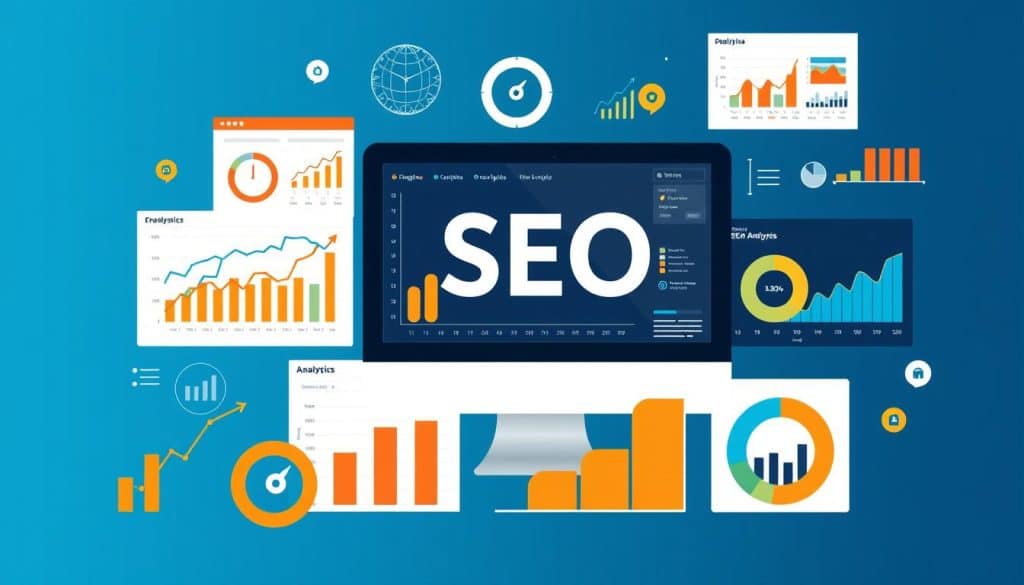
The key to a successful SEO campaign lies in its ability to be measured and tracked effectively. To achieve this, we need to focus on the right metrics and utilize the appropriate tools.
Essential SEO Metrics to Monitor
To understand the effectiveness of your SEO efforts, it’s crucial to monitor both leading and lagging indicators. Leading indicators include metrics such as keyword rankings and visibility, while lagging indicators comprise traffic and conversion rates.
At different stages of your SEO campaign, certain metrics provide more valuable insights than others. For instance, during the initial stages, tracking keyword rankings and organic traffic can offer a clear picture of your campaign’s progress.
Organic traffic analysis should go beyond mere visitor counts to examine the quality, engagement, and conversion potential of your traffic. This involves assessing metrics such as bounce rate, time on site, and conversion rates to gauge the effectiveness of your SEO strategy.
SEO Analytics Tools
To effectively track and measure SEO success, leveraging the right analytics tools is indispensable. Google Search Console and Google Analytics are two fundamental tools that provide complementary data sets, creating a comprehensive picture of your website’s performance.
Google Search Console helps you understand what queries lead people to your page and which ones prompt them to click. This information can be invaluable in identifying additional keywords to target and optimizing your content accordingly.
By setting up these tools correctly and extracting actionable insights from the data they provide, you can attribute leads, sales, and revenue to your SEO efforts, thereby demonstrating the ROI of your SEO campaigns.
Conclusion
Improving your website’s ranking on Google requires a comprehensive strategy that incorporates technical excellence, quality content, and strategic promotion.
We’ve covered comprehensive strategies for improving website ranking on Google, from technical foundations to advanced content optimization techniques. Implementing these proven strategies requires commitment and patience.
- Combine technical excellence with compelling content and strategic promotion.
- For Qatar businesses, localize strategies to address regional search behaviors.
- Focus on creating exceptional user experiences to naturally improve rankings.
By adopting a methodical approach and continuously measuring and refining your SEO strategy, you’ll enhance your website’s visibility in search results and drive more traffic to your site.
FAQ
What are the most important factors in determining a page’s search engine ranking?
We believe that a combination of factors, including quality content, site speed, and user experience, play a crucial role in determining a page’s search engine ranking. By focusing on these key areas, businesses can improve their online visibility and drive more traffic to their site.
How do I conduct effective keyword research for my business?
To conduct effective keyword research, we recommend identifying relevant terms and phrases that align with your business goals and target audience. This involves analyzing search intent, search volume, and competitor activity to inform your keyword strategy.
What is the ideal content length for SEO purposes?
While there’s no one-size-fits-all answer, we generally recommend creating in-depth, high-quality content that provides value to users. This can range from 500 to 2,000 words or more, depending on the topic and context.
How can I optimize my site’s images for better search engine rankings?
To optimize your site’s images, we suggest using descriptive file names, alt tags, and compressing images to reduce file size. This can help improve page load times and make your content more accessible to users.
What role do backlinks play in SEO, and how can I acquire high-quality links?
Backlinks remain a key ranking factor, as they indicate to search engines that your content is trustworthy and relevant. We recommend focusing on quality over quantity and using tactics like guest blogging, resource pages, and broken link building to acquire high-quality links.
How can I measure the success of my SEO efforts?
To measure the success of your SEO efforts, we recommend tracking key metrics like organic traffic, keyword rankings, and conversion rates. By monitoring these metrics, you can refine your SEO strategy and make data-driven decisions to drive more revenue.
What is the importance of mobile-friendliness in SEO, and how can I ensure my site is mobile-friendly?
With the majority of users accessing the web via mobile devices, a mobile-friendly design is crucial for both user experience and search engine rankings. We recommend using responsive design, mobile-friendly themes, and testing your site on various devices to ensure a seamless user experience.
How often should I update my site’s content to improve search engine rankings?
While there’s no specific frequency, we recommend regularly updating your site with fresh, high-quality content to signal to search engines that your site is active and relevant. This can involve blog posts, news updates, or refreshing existing content to keep it relevant and accurate.