

Are you investing in online marketing without a clear plan, wondering why your returns aren’t meeting expectations?
In today’s competitive online landscape, a well-structured marketing strategy is crucial for business success. According to a Smart Insights report, only 17 percent of businesses clearly define their digital marketing strategies.
We’ll explore how an effective digital approach can significantly maximize your return on investment. By understanding your target audience and leveraging the right online channels, you can drive measurable results and achieve your business objectives.
Key Takeaways
- Understand the importance of a well-structured digital marketing plan
- Learn how to identify and connect with your target audience
- Discover the essential components of an effective marketing strategy
- Explore the latest digital marketing trends in Qatar’s unique market
- Develop a clear roadmap for implementing a successful digital marketing strategy
The Value of Strategic Digital Marketing
As digital marketing continues to evolve, the importance of a structured marketing strategy cannot be overstated. In today’s complex digital landscape, businesses need a clear plan to navigate the multitude of customer touchpoints effectively.
The complexity of digital marketing is a key reason why a defined marketing strategy is needed, particularly by medium to large businesses. Our visual gives a B2B example of the complexity of customer touchpoints on the path to purchase that need to be part of a plan.
Why Random Marketing Efforts Fall Short
Random, uncoordinated marketing efforts typically fail to deliver sustainable results. Despite sometimes generating short-term wins, businesses without a strategic marketing approach often waste resources on tactics that don’t align with their overall business objectives.
- Our analysis shows that such businesses often lack a clear direction, leading to inefficient use of resources.
- We’ll examine why a lack of coherence in marketing activities hinders long-term success.
The ROI Benefits of a Structured Approach
A structured digital marketing approach creates measurable ROI through systematic planning, implementation, and optimization. By adopting a data-driven decision-making process, businesses can allocate resources more effectively and track performance with clarity.
| Marketing Approach | Characteristics | ROI Impact |
|---|---|---|
| Random/Uncoordinated | Lack of clear strategy, inefficient resource use | Low/Variable |
| Structured/Strategic | Systematic planning, data-driven decisions | High/Measurable |
For more insights on amplifying your online marketing efforts, visit our page on effective paid media to learn how it can enhance your overall marketing strategy and drive effective results.
“A strategic marketing approach ensures all marketing activities work in harmony toward common goals.”
What Is a Digital Marketing Strategy?
A well-crafted digital marketing strategy is crucial for businesses aiming to thrive in today’s competitive online landscape. It serves as a roadmap for achieving marketing objectives through the effective use of digital media, data, and technology, as defined by Dr. Dave Chaffey in his book “Digital Marketing: Strategy, Implementation and Practice”.
Definition and Core Components
A digital marketing strategy is a comprehensive plan that outlines how a business will leverage digital channels to achieve its marketing objectives and support overall business goals. The core components of a digital marketing strategy include:
- Clear marketing objectives aligned with business goals
- Understanding of the target audience and their digital behavior
- Selection of appropriate digital channels and tactics
- Integration with traditional marketing efforts
- Measurement and evaluation of performance using data and analytics
By incorporating these elements, businesses can create a cohesive marketing strategy that drives results.
How Digital Strategy Differs from Traditional Marketing
Digital marketing strategies differ significantly from traditional marketing approaches in several key areas. The table below highlights some of the main differences:
| Aspect | Digital Marketing | Traditional Marketing |
|---|---|---|
| Targeting | Precise audience targeting using data and analytics | Broad, less targeted approach |
| Measurement | Real-time tracking and measurement of campaign performance | Limited measurement capabilities |
| Optimization | Continuous optimization based on data insights | Limited ability to adjust campaigns in real-time |
| Agility | Quick response to market changes and customer behavior | Slower response times due to longer production cycles |

As shown in the table, digital marketing offers greater flexibility, precision, and measurability compared to traditional marketing methods. By understanding these differences, businesses can create a more effective marketing plan that integrates both digital and traditional approaches.
The Digital Marketing Landscape in Qatar
As Qatar continues to embrace digital transformation, its digital marketing landscape is becoming increasingly sophisticated. The country’s high internet penetration rates and tech-savvy population make it an attractive market for businesses looking to leverage marketing strategies.
Current Trends and Consumer Behavior
Our research into Qatari consumer behavior reveals distinct patterns in digital media consumption and online purchasing decisions. The high smartphone penetration rate in Qatar significantly influences digital marketing strategy development and mobile optimization requirements. We analyze the unique marketing landscape in Qatar, highlighting specific trends that differentiate it from other markets.
Qatari consumers are increasingly using social media platforms, making it a crucial channel for reaching the target audience. For more insights on the latest trends, you can download our comprehensive report on Digital Marketing Trends.
Most Effective Digital Channels for Qatar's Market
To effectively reach Qatari audiences, businesses must identify the most effective digital channels. Search marketing is particularly important when there is high search intent, i.e., people are searching for your products and services. For businesses with a strong online presence, optimizing their website for search engines is crucial.
For businesses looking to expand their reach, social media and display advertising on various platforms can be highly effective. By understanding the competitive marketing landscape in Qatar across various industry sectors, businesses can develop targeted strategies to stand out.
Setting SMART Goals for Your Digital Strategy
A well-crafted digital marketing strategy begins with setting SMART goals that drive results. SMART is an acronym that stands for Specific, Measurable, Achievable, Relevant, and Time-bound. By establishing clear objectives, businesses can focus their efforts and resources on achieving tangible outcomes.
Defining Clear Marketing Objectives
Defining clear marketing objectives is crucial for the success of any digital marketing strategy. As noted by experts, “At the simplest level, you need to measure what you set out to achieve with your marketing objectives.” For instance, metrics like impressions can be used to gauge the effectiveness of a strategy at the awareness stage. Setting SMART marketing objectives enables businesses to track progress and make data-driven decisions.
- Establish specific goals that directly support your overall business growth targets.
- Ensure your objectives are measurable, allowing for the tracking of progress.
- Align your digital marketing goals with specific business outcomes, such as revenue growth or customer retention.
Aligning Digital Goals with Business Growth
Aligning digital marketing goals with business growth is essential for maximizing ROI. By cascading high-level business objectives into tactical digital marketing goals, teams can execute against clear targets. For example, if a business aims to expand its market share, the digital marketing strategy could focus on increasing brand awareness through targeted campaigns.
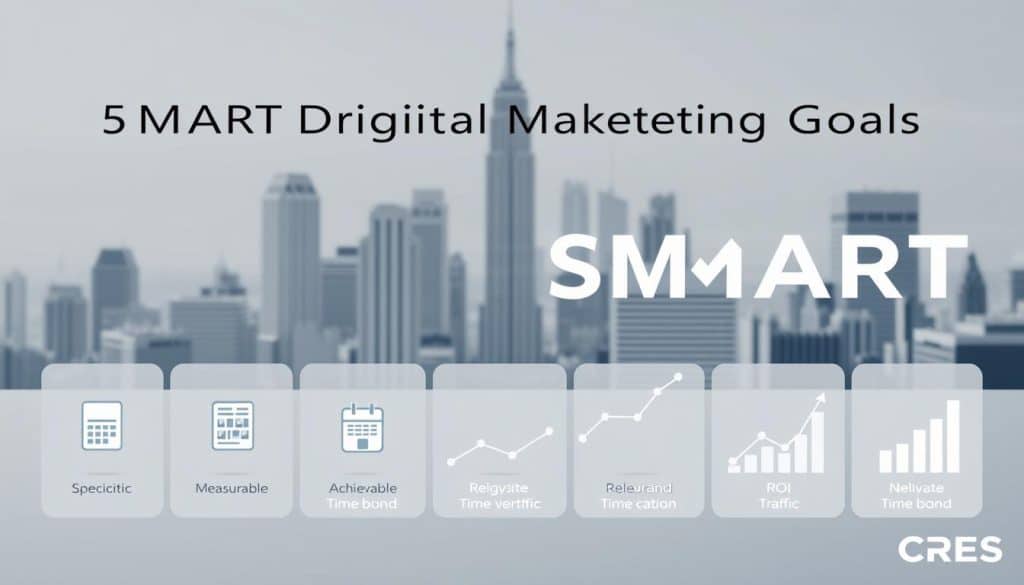
By establishing meaningful KPIs, businesses can accurately measure progress toward their digital marketing goals. This approach ensures that every digital marketing activity can be traced back to a specific business objective, creating clear accountability and driving success.
Building Comprehensive Buyer Personas
To maximize ROI, it’s essential to develop a deep understanding of your customer through comprehensive buyer personas. Building these personas involves gathering and analyzing data about your target audience to create accurate representations of your ideal customers.
To get a well-rounded picture of your persona, your research pool should include customers, prospects, and people outside your contacts database who align with your target audience. The information you gather will depend on your business, varying by whether you’re B2B or B2C or sell high-cost or low-cost products.
Collecting Demographic and Behavioral Data
Our methodology combines quantitative research with qualitative insights for richer persona development. You’ll learn techniques for gathering both explicit data (what customers tell you) and implicit data (what their behaviors reveal) to create more accurate personas.
For instance, demographic data such as age, gender, and location can provide a foundational understanding of your audience. Behavioral data, on the other hand, reveals how your customers interact with your brand, including their purchasing habits and engagement with your content.
Creating Actionable Audience Segments
We’ll demonstrate how to transform raw customer data into actionable audience segments that can be targeted effectively across digital channels. By doing so, you can tailor your content creation, channel selection, and messaging strategies to resonate with your target audience.
| Persona Characteristics | Data Points | Marketing Implications |
|---|---|---|
| Demographics | Age, Gender, Location | Targeted Advertising |
| Behavioral Patterns | Purchase History, Content Engagement | Personalized Content |
| Preferences | Surveys, Feedback | Improved Customer Experience |
By following this approach, you can develop a robust digital marketing strategy that resonates with your target audience and drives business growth.
Conducting a Digital Marketing Audit
Conducting a digital marketing audit helps businesses identify areas for improvement and opportunities for growth. To start, audit your existing digital marketing channels and assets to determine what to incorporate in your strategy. It’s helpful to first consider the big picture—this will prevent you from feeling overwhelmed or confused.
Gather what you have and categorize each vehicle or asset in a spreadsheet so you have a clear picture of your existing owned, earned, and paid media. This process will help you understand your current digital marketing standing.
Evaluating Your Current Digital Presence
To evaluate your current digital presence, we outline a comprehensive framework for conducting a thorough digital marketing audit that assesses all aspects of your current digital presence. Our audit methodology helps you systematically assess your website performance, content effectiveness, social media engagement, and search.
We’ll show you how to use analytics tools to gather quantitative data about your digital marketing performance across channels. This step is crucial for understanding what’s working and what areas need improvement.
Identifying Gaps and Opportunities
By analyzing the data collected during the audit, you’ll learn how to identify critical gaps in your marketing strategy that may be limiting your results. We’ll demonstrate how to spot hidden opportunities in your existing digital assets that could be optimized for better performance.
Our competitive analysis approach helps you benchmark your digital presence against key competitors to identify relative strengths and weaknesses. This insight will enable you to make informed decisions about where to focus your marketing efforts.
The RACE Framework for Digital Marketing Strategy
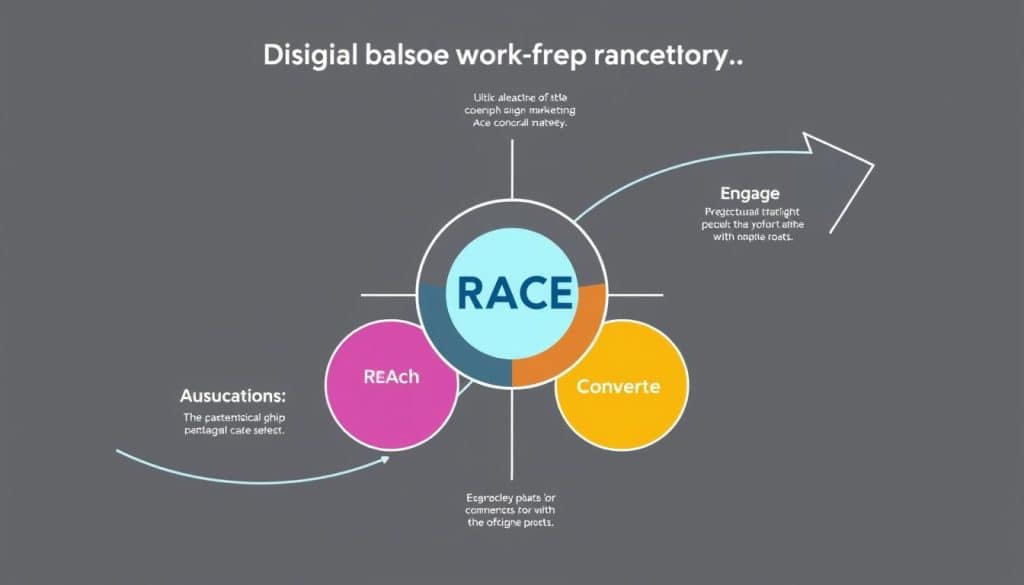
To maximize ROI, businesses need a structured approach to digital marketing, which is where the RACE framework comes into play. Our RACE Growth System is designed to improve marketing effectiveness by providing a comprehensive framework and process for digital marketing strategy development.
Understanding the Four Stages: Reach, Act, Convert, Engage
The RACE framework is built around four critical stages: Reach, Act, Convert, and Engage. Each stage plays a vital role in the customer journey, from initial awareness to conversion and retention.
Reach: This stage focuses on building brand awareness and attracting potential customers through various digital channels, such as search engine optimization (SEO), pay-per-click (PPC) advertising, and social media marketing.
Act: In this stage, businesses interact with their audience, encouraging them to take specific actions, such as signing up for a newsletter or downloading a whitepaper.
Convert: The convert stage is where leads are turned into customers through strategic content and offers, such as free trials or demos.
Engage: Finally, the engage stage involves nurturing customer relationships through ongoing communication and value delivery, fostering loyalty and repeat business.
Implementing the OSA Improvement Process
The OSA (Opportunity, Strategy, Action) improvement process is a crucial component of our RACE Growth System. It provides a structured approach to optimizing digital marketing performance.
The OSA process involves:
- Identifying Opportunities for growth through market analysis and customer insights.
- Developing a Strategy that aligns with business objectives and customer needs.
- Implementing Action plans that drive results through targeted digital marketing tactics.
By combining the RACE framework with the OSA improvement process, businesses can create a powerful digital marketing strategy that drives sustainable growth and maximizes ROI.
Content Strategy: Driving Engagement and Conversions
Crafting a content strategy that drives engagement and conversions requires a deep understanding of your customer journey. We need to develop a comprehensive approach that aligns with your buyer personas and supports each stage of the customer journey.
To achieve this, we must first understand the diverse needs and pain points of our target audience in Qatar. By doing so, we can create content that informs, entertains, and engages them across various touchpoints.
Developing a Content Plan Based on Customer Journey
Developing a content plan involves several key steps. We start by identifying the types of content that resonate with our audience at different stages of their journey. This includes understanding their preferences for content formats such as blog posts, videos, infographics, and interactive tools.
Our methodology ensures that we create the right content types for each phase of the buying process. For instance, educational content works well during the awareness stage, while more persuasive content is effective during the consideration stage.
- Identify customer needs and pain points
- Develop content that addresses these needs
- Map content to specific stages of the customer journey
Content Types and Distribution Channels
The effectiveness of our content strategy also depends on the distribution channels we use. We need to optimize our content distribution across owned, earned, and paid channels for maximum visibility.
For example, we can use social media platforms to reach a wider audience, while blog posts can help establish our brand as a thought leader in the industry. The key is to choose the right channels based on where our target audience is most active.
| Content Type | Distribution Channel | Target Audience |
|---|---|---|
| Blog Posts | Owned Media (Website) | Industry Professionals |
| Videos | Social Media (YouTube, Facebook) | General Audience |
| Infographics | Earned Media (PR, Social Sharing) | Industry Influencers |
By understanding our audience and leveraging the right content types and distribution channels, we can drive engagement and conversions effectively.
Optimizing Your Digital Marketing Channels
To maximize ROI, it’s crucial to optimize your digital marketing channels effectively. This involves categorizing your digital assets into owned, earned, and paid media to determine the best fit for your strategy.
Owned Media: Website, Blog, and Email
Owned media includes digital assets your brand owns, such as your website, blog, and email marketing lists. Optimizing these channels involves technical and content improvements to maximize performance. For instance, enhancing your website’s user experience and search engine optimization (SEO) can significantly boost your online presence. Regularly updating your blog with high-quality, relevant content can drive engagement and attract potential customers. Similarly, refining your email marketing strategy to personalize and segment your communications can lead to higher conversion rates.
Earned Media: PR and Social Sharing
Earned media refers to coverage or content created about your business without paid advertising, such as PR and social sharing. Strategies to amplify your brand message through earned media include crafting compelling press releases, leveraging influencer partnerships, and encouraging social sharing through engaging content. As noted by marketing expert,
“The key to successful earned media is creating content that is newsworthy and shareable.”
By focusing on these areas, you can increase your brand’s visibility and credibility.
Paid Media: PPC, Social Ads, and Display
Paid media involves channels where you spend money to reach your target audience, including PPC, social ads, and display advertising. Developing an effective paid media strategy requires understanding your buyer personas and selecting the right platforms to reach them. For example, using targeted social ads can help you reach a specific demographic, while PPC campaigns can drive immediate traffic to your website. By allocating your budget effectively across these channels, you can achieve maximum impact and drive conversions.
By optimizing your digital marketing channels across owned, earned, and paid media, you can create a comprehensive strategy that drives business growth and maximizes ROI.
Crafting a Compelling Value Proposition
Crafting a compelling value proposition is crucial for differentiating yourbrandin a crowded digital landscape. A well-defined value proposition serves as the foundation for yourmarketingstrategy, helping you stand out from competitors and resonate with your targetaudience.
Defining Your Unique Value Claim
To create a compelling value proposition, you need to identify your unique value claim. This involves understanding your targetaudience, your competitive set, and the justifications for yourbrandvalue. As noted by Gupta in DigitalMarketingStrategy, “If you want to convince consumers to buy yourproduct, you need to give them a compelling reason to purchase yourbrandinstead of a competingbrand.” We guide you through the process of crafting a compelling value proposition by identifying your unique strengths and differentiators. Our framework helps you articulate your most powerful competitive differentiators, ensuring a strongmarketingedge.
Communicating Value Across Digital Touchpoints
Once you’ve defined your unique value claim, it’s essential to communicate it consistently across all digital touchpoints. This includes your website, social media, emailmarketingcampaigns, andcontentstrategy. We help you develop a cohesivecontentplan that aligns with your customer journey, ensuring that your value proposition is conveyed effectively at every stage. By leveraging various digital channels, includingeffective website design, you can maximize the impact of your value proposition and drivebusinessgrowth. Our approach includes adapting your value messaging for differentaudiencesegments while maintainingbrandconsistency, and testing different value proposition articulations to identify the most effectivemarketingmessaging.
By consistently communicating your value proposition across digital touchpoints and refining it based on customer feedback andmarketingperformance, you can strengthen yourbrandpresence and drive long-termbusinesssuccess. Effectivecontentstrategy plays a crucial role in this process, helping to engage your targetaudienceand convey your unique value claim.
Implementing User Experience (UX) Design
To maximize ROI, it’s essential to implement a user experience (UX) design that is both functional and enjoyable. Your website or app needs to be clear, intuitive, and frustration-free to prevent losing potential customers.
We outline the critical principles of UX design that directly impact your digital marketing effectiveness and conversion rates. A good UX design encompasses several key elements, including clear navigation, simple forms, mobile-friendly design, and fast loading speed.
Mobile-First Design Principles
A mobile-first design approach ensures your digital properties perform optimally on smartphones and tablets. With most users accessing content on mobile devices, a mobile-friendly design is crucial. This involves creating a responsive design that adapts to different screen sizes and devices.
| Device | Screen Size | Design Consideration |
|---|---|---|
| Smartphone | Small | Simple navigation, clear CTAs |
| Tablet | Medium | Balanced content and visuals |
| Desktop | Large | Detailed content, complex interactions |
Optimizing Website Navigation and Speed
Optimizing website navigation and information architecture can significantly improve user engagement and conversion metrics. This involves simplifying menus, reducing the number of clicks to reach key pages, and ensuring that your website loads quickly.
By improving website loading speed, you can keep visitors engaged and improve user experience. Techniques for improving speed include optimizing images, leveraging browser caching, and minimizing HTTP requests.
By implementing these UX design principles, you can create a seamless and intuitive experience for your users, ultimately driving conversions and maximizing ROI.
Measuring ROI: Key Performance Indicators
Measuring the return on investment (ROI) of digital marketing efforts is crucial for businesses to understand the effectiveness of their strategies. To maximize ROI, it’s essential to track and analyze key performance indicators (KPIs) that align with your marketing objectives.
At the simplest level, you need to measure what you set out to achieve with your marketing goals. According to Gupta, certain metrics will be more relevant for specific stages of the funnel. For instance, at the awareness stage, you can focus on metrics like impressions to determine your strategy’s effectiveness.
Selecting the Right Metrics for Each Channel
Selecting the right metrics is crucial for evaluating the success of your digital marketing efforts. Different channels require different metrics. For example, social media campaigns might be measured by engagement rates, while email marketing campaigns could be evaluated based on open rates and conversion rates.
Our approach ensures you focus on indicators that truly reflect business impact rather than vanity metrics. By doing so, you can optimize your strategy as priorities shift throughout the customer journey. Here are some key metrics to consider:
- Impressions and reach for awareness campaigns
- Click-through rates (CTR) for consideration-stage campaigns
- Conversion rates for campaigns aimed at driving sales or leads
| Channel | Primary Metric | Secondary Metric |
|---|---|---|
| Social Media | Engagement Rate | Reach |
| Email Marketing | Open Rate | Conversion Rate |
| Search Engine Optimization (SEO) | Organic Traffic | Keyword Ranking |
Setting Up Analytics and Reporting Dashboards
To effectively measure ROI, you need to set up comprehensive analytics and reporting dashboards. This involves integrating tools like Google Analytics with your website and other digital platforms. By doing so, you can attribute conversions and revenue to specific marketing activities for more accurate ROI calculation.
Our guidance on setting up analytics systems will help you present marketing performance data to executives in ways that clearly communicate business value and ROI. This includes using data visualization techniques and focusing on key metrics that matter most to your business.
Creating Your 90-Day Digital Marketing Plan
To maximize ROI, creating a focused 90-day digital marketing plan is essential. This plan will drive immediate results while building toward long-term objectives.
Prioritizing Strategic Initiatives
To develop an effective 90-day plan, it’s crucial to prioritize strategic initiatives. Our methodology helps identify the highest-impact activities to focus on first. We’ll break down your marketing strategy into manageable 90-day sprints with clear deliverables and success metrics.
When prioritizing initiatives, consider factors such as alignment with business goals, potential impact on ROI, resource availability, and customer needs and preferences.
Implementing an Agile Marketing Approach
An agile marketing approach allows for rapid testing, learning, and optimization. This involves breaking down marketing campaigns into smaller tasks, regularly reviewing progress, and making data-driven adjustments.
The agile approach offers several benefits, including improved responsiveness to market changes, enhanced collaboration among team members, and increased efficiency in campaign execution.
| Aspect | Traditional Marketing | Agile Marketing |
|---|---|---|
| Planning | Long-term plans with fixed objectives | Short-term plans with flexible objectives |
| Execution | Linear execution with minimal adjustments | Iterative execution with continuous adjustments |
| Response to Change | Slow to adapt to changes | Quick to adapt to changes |
Conclusion: Transforming Your Digital Marketing for Maximum ROI
Transforming your digital marketing efforts to achieve maximum ROI requires a strategic and customer-centric approach. As we conclude our comprehensive guide, it’s essential to summarize the key principles that drive business success in Qatar’s competitive digital landscape.
A well-planned digital marketing strategy is crucial for driving measurable results and achieving a significant return on investment. By understanding your target audience, creating actionable buyer personas, and leveraging the most effective digital channels, you can optimize your marketing efforts.
To maintain a competitive edge, it’s vital to continuously monitor and improve your marketing strategy. This involves staying up-to-date with emerging trends, adopting new technologies, and refining your approach based on data-driven insights. By doing so, you’ll be able to maximize your ROI and drive long-term business success.
As Gupta says in Digital Marketing Strategy, “Determining your marketing goals… isn’t always easy. However, as you clarify these components and create your plan, you’ll have a much clearer path ahead toward identifying, acquiring, and retaining customers.” By following the principles outlined in this guide, you’ll be well on your way to achieving remarkable ROI improvements through strategic digital marketing transformation.
FAQ
What is the primary goal of a digital marketing campaign?
The primary goal is to drive revenue growth through targeted online channels, such as search, email, and social media, while maintaining a strong brand presence.
How do I measure the success of my digital marketing efforts?
Success is measured by tracking key performance indicators (KPIs) such as conversion rates, return on ad spend (ROAS), and customer acquisition costs, which provide insights into campaign effectiveness.
What is the importance of buyer personas in digital marketing?
Buyer personas help businesses understand their target audience, tailor content and messaging, and improve customer engagement, ultimately driving more conversions and sales.
How often should I conduct a digital marketing audit?
A digital marketing audit should be conducted regularly, ideally every 6-12 months, to assess campaign performance, identify areas for improvement, and adjust strategies accordingly.
What is the RACE framework, and how does it apply to digital marketing?
The RACE framework is a structured approach to digital marketing that encompasses four stages: Reach, Act, Convert, and Engage, helping businesses plan and optimize their online marketing efforts.
How can I optimize my website for better user experience?
Optimizing your website involves implementing mobile-first design principles, streamlining navigation, and ensuring fast page loading speeds to improve customer engagement and conversion rates.
What role does content play in a digital marketing strategy?
Content is a crucial element in digital marketing, as it helps attract and engage target audiences, build brand credibility, and drive conversions through various channels, such as blogs, social media, and email.
How do I choose the most effective digital marketing channels for my business?
The most effective channels are determined by understanding your target audience, their preferences, and behaviors, as well as analyzing the performance of different channels, such as search, social media, and email.