
The digital landscape is evolving rapidly, with user expectations driving the demand for more sophisticated and responsive web applications. Today, businesses need web applications that are not only visually appealing but also secure, flexible, and scalable to meet the ever-changing demands of the global market.
As we explore the world of web application development, it becomes clear that the traditional approaches are no longer sufficient. The 24/7 availability and cross-device compatibility have become the new norm, pushing developers to adopt innovative strategies and cutting-edge technologies to stay ahead.
Key Takeaways
- Understanding the key characteristics of successful web applications
- Essential architectural considerations for building robust web apps
- The importance of user experience and design in web application development
- Best practices for security, flexibility, and performance optimization
- Leveraging modern development approaches and tools for efficient web app development
The Evolution of Modern Web Applications

We’ve witnessed a substantial transformation in how web applications are developed and experienced by users. The way we interact with web applications has changed dramatically over the past decade, driven by advancements in technology and changing user expectations.
From Traditional to Modern Web Apps
Traditional web applications were characterized by their reliance on server-side processing, resulting in full page reloads for nearly every user interaction. This approach, often implemented using Classic Model-View-Controller (MVC) frameworks, limited the potential for dynamic and responsive user experiences. In contrast, modern web applications have adopted client-side functionality, leveraging technologies like JavaScript frameworks and WebAssembly to deliver more interactive and seamless experiences.
The shift from traditional to modern web apps has been significant. Modern web apps handle complex business logic directly in the browser, reducing server load and improving response times. This evolution has enabled the development of Single Page Applications (SPAs) that provide more fluid user interactions, akin to native desktop applications.
Key Characteristics of Modern Web Applications
So, what defines modern web applications? Key characteristics include responsive design, ensuring that applications adapt to different screen sizes and device capabilities. Modern web apps also prioritize cross-platform compatibility, allowing users to access applications across various devices and browsers. Furthermore, they feature intuitive user interfaces that enhance user experience, making interactions more straightforward and engaging.
Other notable features of modern web applications include the use of service workers for offline functionality, progressive enhancement to ensure compatibility with older browsers, and an API-first design approach that separates concerns and improves maintainability. These advancements have transformed the web application landscape, enabling developers to create more sophisticated, user-centric applications.
Modern Web App Architecture Fundamentals

Modern web app development is underpinned by several key architectural fundamentals that enable scalability, flexibility, and performance. As we explore these foundational elements, it becomes clear that the modern web application landscape is shaped by a combination of cloud computing, containerization, and microservices.
Cloud-Hosted and Scalable Design
Cloud-hosted architecture is a cornerstone of modern web app development, providing the scalability needed to handle varying user loads without excessive infrastructure investment. For instance, ASP.NET Core is optimized for cloud environments, offering low-memory usage and high-throughput capabilities. This results in reduced hosting costs and improved application performance.
Key benefits of cloud-hosted design include:
- Scalability to handle fluctuating user demands
- Reduced infrastructure costs through efficient resource utilization
- Enhanced performance and reliability
Cross-Platform Compatibility
Modern web applications are increasingly designed with cross-platform compatibility in mind, ensuring seamless functionality across different operating systems, browsers, and devices. ASP.NET Core, for example, is cross-platform, capable of running on Linux, macOS, and Windows. This flexibility opens up a broader range of development and deployment options.
Modular and Loosely Coupled Components
The shift toward modular, loosely coupled components represents a significant advancement in web app architecture. This approach enables development teams to work on separate application components simultaneously without creating dependencies. By leveraging technologies like Docker containers and microservices, developers can package applications with their dependencies, ensuring consistent behavior across environments.
Some key advantages of modular architecture include:
- Improved development efficiency through parallel workstreams
- Enhanced maintainability and scalability
- Better fault isolation and reduced risk
By embracing these architectural fundamentals, developers can create modern web applications that are not only scalable and flexible but also highly performant and user-friendly. As the web development landscape continues to evolve, staying abreast of these key principles will be crucial for delivering successful web applications.
Essential Design Principles for Modern Web Apps
As technology advances, the design principles for modern web applications have become more sophisticated, focusing on user experience and interactivity. The way users interact with web applications has undergone a significant transformation, driven by the need for more intuitive, responsive, and engaging digital experiences.
Modern web applications require a deep understanding of various design principles to ensure they meet user expectations and provide a competitive edge. We will explore some of the key design principles that are shaping the modern web development landscape.
Single Page Applications vs. Traditional Web Apps
Single Page Applications (SPAs) have revolutionized the way users interact with web applications by eliminating full page reloads and creating smoother, more app-like interactions. Unlike traditional web applications, SPAs involve very few dynamically generated server-side page loads. Many SPAs are initialized within a static HTML file that loads the necessary JavaScript libraries to start and run the app. For instance, frameworks like Blazor WebAssembly enable developers to build SPAs using .NET code, which then runs in the client’s browser. To learn more about how SPAs are implemented, you can refer to our detailed guide on web application architecture.
The use of SPAs has become increasingly popular due to their ability to provide rich user experiences. They make heavy usage of web APIs for their data needs, reducing the load on the server and improving perceived performance and responsiveness for users.
Progressive Web Apps (PWAs)
Progressive Web Apps (PWAs) represent a significant advancement in web application design, combining the best features of web and native applications to deliver reliable, fast, and engaging experiences. PWAs provide a native app-like experience to users, with features such as offline capabilities, push notifications, and home screen installation.
The key benefit of PWAs is their ability to work across different platforms and devices, providing a consistent user experience. This is particularly important in today’s multi-device world, where users expect seamless interactions across various devices.
Responsive and Adaptive Design
Responsive and adaptive design principles have become essential in modern web development, ensuring that applications function optimally across devices ranging from desktop monitors to mobile phones. A responsive design adapts to the user’s device, providing an optimal viewing experience regardless of screen size or orientation.
By incorporating responsive and adaptive design principles, developers can create web applications that are accessible to a wider audience, improving user engagement and overall satisfaction. This approach also helps in reducing development costs by minimizing the need for separate applications for different devices.
UI/UX Best Practices in Modern Web Apps
As we continue to evolve in the digital landscape, the importance of UI/UX in modern web applications cannot be overstated. UI, or User Interface, refers to the visual elements and interactions users encounter when using a web application, including buttons, colors, fonts, and navigation. UX, or User Experience, focuses on the overall experience and satisfaction a user derives from interacting with the application.
User Interface Design Trends
Successful modern web apps prioritize intuitive user interfaces that reduce cognitive load and guide users naturally through complex processes. We’ve identified that minimalist design approaches have gained prominence, focusing on essential elements while eliminating visual clutter. Microinteractions and subtle animations have become powerful tools for providing feedback and enhancing the user experience.
For instance, incorporating personalization features that adapt content and functionality based on user preferences and behavior patterns can significantly enhance the user experience. By leveraging effective web design and SEO integration, businesses can maximize their ROI and drive growth.
User Experience Optimization Strategies
Data-driven UX optimization has transformed how development teams approach design decisions. By using analytics and user testing, teams can identify pain points and iteratively improve the experience. Modern web apps increasingly incorporate features that adapt to user needs, enhancing overall satisfaction and engagement.
To optimize UX, it’s essential to conduct thorough user research, utilizing tools like heat mapping and session recording to gain deeper insights into user interactions.
Accessibility and Inclusivity
Accessibility has evolved from a compliance checkbox to a fundamental design principle. Modern web applications now incorporate features like keyboard navigation, screen reader compatibility, and sufficient color contrast to ensure inclusivity. By prioritizing accessibility, businesses can cater to a broader audience, including users with disabilities.
Design systems have become essential tools for maintaining consistency across complex web applications, providing reusable components that ensure visual and functional coherence. This approach not only enhances user experience but also streamlines development processes.
Frontend Technologies and Frameworks

Modern web applications rely heavily on robust frontend technologies and frameworks to deliver seamless user experiences. The landscape of frontend development is characterized by a plethora of tools and frameworks, each with its strengths and ideal use cases.
JavaScript Frameworks
JavaScript frameworks have been at the forefront of frontend development, revolutionizing how we build interactive user interfaces. Frameworks like React, Angular, and Vue.js have gained widespread adoption due to their ability to provide structured approaches to building complex web applications with reusable components.
For instance, React’s component-based architecture allows developers to create modular, maintainable code that can be easily tested and reused across different parts of an application. Similarly, Angular’s opinionated framework provides a robust set of tools for building complex applications, while Vue.js offers a more flexible and approachable alternative.
CSS Frameworks and Preprocessors
CSS frameworks and preprocessors have dramatically improved developer productivity by providing ready-made components and simplifying the process of writing maintainable stylesheets. Tools like Sass and Less extend CSS with features such as variables, nested rules, and mixins, making it easier to manage complex stylesheets.
Furthermore, CSS frameworks like Bootstrap and Tailwind CSS offer pre-designed UI components and utility classes that can significantly speed up the development process. By leveraging these tools, developers can focus on creating unique and engaging user experiences while maintaining a consistent design language throughout the application.
Backend Technologies for Modern Web Apps
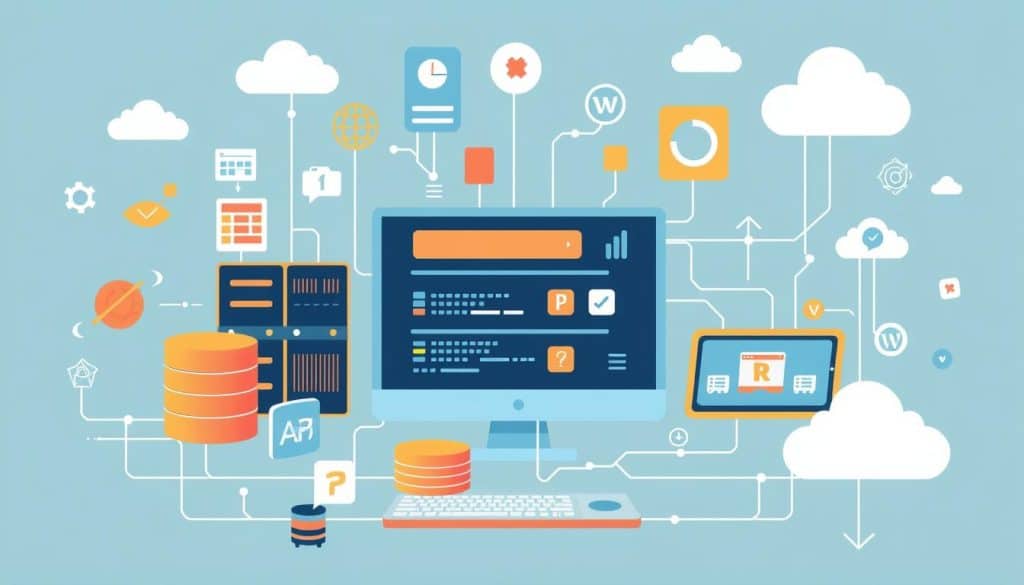
As web applications become increasingly complex, the importance of efficient backend technologies cannot be overstated. Modern web applications rely on robust backend systems to deliver seamless user experiences and drive business success.
Server-Side Languages and Frameworks
Server-side languages and frameworks play a crucial role in building scalable and secure web applications. For instance, ASP.NET Core is optimized for modern web applications and cloud-based hosting scenarios, offering a modular design that improves application security and performance. This framework supports unit testing and dependency injection, making it easier to manage complex applications.
API Development and Management
Effective API development and management are critical for modern web applications. RESTful API design principles have become fundamental, providing standardized interfaces for seamless communication between frontend and backend components. Backend technologies such as GraphQL have also emerged, offering more control over data retrieval and reducing over-fetching issues.
Serverless Architecture
Serverless computing has transformed backend development by allowing developers to focus on writing code rather than managing infrastructure. This approach automatically scales to meet demand, improving efficiency and reducing costs. Serverless architecture is particularly beneficial for applications with variable or unpredictable workloads.
Implementing Microservices Architecture
Modern web applications are increasingly adopting microservices architecture to leverage benefits such as independent scalability, technology diversity, and improved fault isolation. This architectural style structures an application as a collection of small, autonomous services, each designed to perform a specific business capability.
Advantages for Web Applications
Microservices offer several significant advantages for modern web applications. These include the ability to scale individual components independently, which can lead to more efficient resource utilization. Additionally, microservices allow for the use of diverse technologies, enabling developers to choose the best tool for each specific task.
We have identified that microservices architecture offers significant benefits, including:
- Independent scalability and technology diversity
- Resilience through isolation of failures
- Flexibility in development and deployment
Decoupling Monolithic Applications
To implement microservices, existing monolithic applications often need to be decoupled. This involves breaking down the application into smaller, independent services. The process requires careful analysis to identify service boundaries and evaluate the benefits of decoupling specific components.
For instance, in an e-commerce application, order checkout and order processing can be separated into distinct services, allowing for independent scaling and more efficient resource management.
Service Communication Patterns
Effective service communication is crucial in a microservices architecture. Different patterns, such as synchronous REST APIs, asynchronous messaging, and event-driven architectures, offer various trade-offs in terms of complexity, scalability, and fault tolerance.
| Communication Pattern | Characteristics | Use Cases |
|---|---|---|
| Synchronous REST APIs | Request-response model, tightly coupled | Simple, real-time interactions |
| Asynchronous Messaging | Loosely coupled, fault-tolerant | Complex workflows, background processing |
| Event-Driven Architecture | Highly decoupled, scalable | Real-time data processing, microservices integration |
By understanding and implementing these microservices architecture principles, developers can create modern web applications that are more resilient, scalable, and adaptable to changing business needs.
Containerization and Deployment Strategies
Containerization has revolutionized the way we deploy web applications, offering a consistent and reliable environment across development, testing, and production stages. This shift has been instrumental in simplifying dependency management and enhancing the overall efficiency of the deployment process.

Docker and Kubernetes for Web Apps
Docker has become the industry standard for containerizing web applications, allowing developers to package their code along with all dependencies into portable, isolated containers. Kubernetes has emerged as the leading orchestration platform for containerized applications, providing automated deployment, scaling, and management capabilities for complex web apps.
Key Benefits: Consistent environments across development, testing, and production; simplified dependency management; enhanced scalability and reliability.
CI/CD Pipeline Implementation
Modern CI/CD pipelines have transformed how web applications are delivered, enabling frequent, reliable deployments through automated testing and deployment processes. Infrastructure as Code (IaC) practices have become essential for managing modern web app environments, ensuring consistency and reproducibility while enabling version control of infrastructure configurations.
Best Practices: Implementing blue-green and canary deployment strategies to reduce the risk associated with releasing new versions of web applications; leveraging container registries for version control of application artifacts; utilizing service meshes for managing communication between containerized services.
By adopting containerization and advanced deployment strategies, we can significantly improve the efficiency, reliability, and scalability of modern web applications. This approach not only streamlines the development process but also enhances the overall user experience.
Testing Strategies for Modern Web Applications
In the realm of modern web applications, testing is not just a necessity but a cornerstone of their development and maintenance. As we strive to deliver high-quality web applications, comprehensive testing strategies become essential to ensure their reliability, performance, and security throughout their lifecycle.
Automated testing has become a fundamental aspect of modern web development, providing different levels of confidence in application functionality through unit, integration, and end-to-end tests. Test-driven development (TDD) approaches have gained widespread adoption, encouraging developers to write tests before implementing features, which leads to more maintainable and well-designed code.
Automated Testing Approaches
We’ve seen a significant shift towards automated testing in modern web applications. This approach includes various testing methods such as unit testing, integration testing, and end-to-end testing. For instance, ASP.NET Core applications support unit testing, and their loose coupling and support for dependency injection make it easy to swap infrastructure concerns with fake implementations for test purposes.
Performance Testing
Performance testing has evolved to address the unique challenges of modern web apps. It’s not just about measuring server response times; it also involves client-side metrics like Time to Interactive and First Contentful Paint. Load testing tools have become more sophisticated, allowing teams to simulate realistic user behavior patterns and identify bottlenecks before they impact real users.
Security Testing
Security testing has become increasingly automated, with static analysis tools, dependency scanners, and dynamic application security testing integrated into CI/CD pipelines. This ensures that security vulnerabilities are identified and addressed early in the development process, enhancing the overall security posture of the web application.
By adopting comprehensive testing strategies, we can ensure that modern web applications are reliable, performant, and secure, ultimately providing a better experience for users.
Security Best Practices for Modern Web Apps
Modern web apps demand robust security practices to safeguard against increasingly sophisticated threats. As we continue to develop and deploy web applications, it’s crucial that we integrate security throughout the development lifecycle, rather than treating it as an afterthought.
Authentication and Authorization
We’ve observed significant advancements in authentication systems, with OAuth2.0 and OpenID Connect emerging as standard protocols for securing modern web applications. These protocols not only enhance security but also provide a seamless user experience. Authorization frameworks have also become more sophisticated, implementing fine-grained permission models that go beyond simple role-based access control to meet complex business requirements.
Data Protection and Privacy
Data protection strategies must address both data in transit and at rest. Encryption, proper key management, and secure storage practices form the foundation of a comprehensive approach. Privacy considerations have become increasingly important in web app development, with regulations like GDPR and CCPA requiring careful handling of user data and explicit consent mechanisms.
Common Security Threats and Mitigation
Security headers and Content Security Policy implementations provide critical protection against common web vulnerabilities like XSS and clickjacking with minimal development effort. Dependency management has become a critical security concern, with automated scanning tools helping to identify and remediate vulnerabilities in third-party libraries before they can be exploited.
By integrating these security best practices into our development workflow, we can significantly enhance the security posture of our modern web applications, protecting both our users and our businesses from emerging threats.
Conclusion: Future Trends in Modern Web App Development
As we look to the future, the landscape of web application development continues to evolve at a rapid pace. We’ve explored the comprehensive landscape of modern web app development, from architecture fundamentals to security best practices, providing a roadmap for building robust, scalable applications.
The future of web application development is trending toward greater decoupling of services, with micro-frontends complementing microservices. Emerging trends like WebAssembly and edge computing will transform web apps by enabling near-native performance and reducing latency. AI and machine learning integration will enhance web applications, offering personalized user experiences and automated optimization.
These advancements will continue to blur the line between web and native applications, with Progressive Web Apps leading the way. As web application development continues to mature, we can expect more sophisticated orchestration and state management capabilities, particularly in serverless architectures.
FAQ
What are the key characteristics of a successful application design?
A successful application design is centered around the user experience, with a focus on intuitive interfaces, responsive design, and streamlined functionality. We prioritize user interface design that is both aesthetically pleasing and optimized for user engagement.
How do I choose the right frontend technologies for my web application?
When selecting frontend technologies, consider factors such as project requirements, team expertise, and scalability needs. Popular choices include JavaScript frameworks like React, Angular, and Vue, as well as CSS frameworks and preprocessors.
What is the difference between a Single Page Application and a traditional web app?
Single Page Applications load a single HTML page and dynamically update the content, whereas traditional web apps load multiple HTML pages. This difference affects user experience, application performance, and development approaches.
How can I ensure cross-platform compatibility for my web application?
To achieve cross-platform compatibility, we use responsive design, progressive web apps, and modular architecture. This ensures that your web application works seamlessly across various devices, browsers, and operating systems.
What are the benefits of using a microservices architecture for my web application?
A microservices architecture allows for greater scalability, flexibility, and resilience. By decoupling monolithic applications into smaller services, we can improve development efficiency, deployment speed, and overall application performance.
How do I implement effective testing strategies for my web application?
Effective testing strategies involve a combination of automated testing approaches, performance testing, and security testing. We prioritize comprehensive testing to ensure your web application is reliable, efficient, and secure.
What are the best practices for security in web application development?
To ensure security in web application development, we follow best practices such as authentication and authorization, data protection and privacy, and common security threat mitigation. This protects your web application from potential vulnerabilities and threats.
How can I optimize the user experience for my web application?
To optimize the user experience, we focus on user interface design trends, user experience optimization strategies, and accessibility and inclusivity. By prioritizing user needs and behavior, we create a seamless and engaging experience.