
Can your hotel afford to be invisible online?
In today’s digital landscape, a robust online presence is crucial for hotels in Qatar to drive revenue growth and stay competitive. We explore how targeted search engine optimization can transform your website, increasing visibility and direct bookings while reducing dependency on commission-based OTAs.
By implementing effective SEO strategies, your hotel can climb search engine rankings, capture more of the growing online travel market, and ultimately boost revenue.
Key Takeaways
- Discover how SEO can increase your hotel’s online visibility and drive direct bookings.
- Learn actionable strategies to improve your website’s search engine rankings.
- Understand the importance of content optimization for your hotel’s online presence.
- Explore the impact of technical SEO on your hotel’s bottom line.
- Gain insights into the growing online travel market in Qatar and how to capture it.
Understanding SEO in the Hospitality Context
The hospitality sector requires a tailored approach to SEO, differing significantly from standard practices due to the unique behaviors of travelers. Search engine optimization (SEO) is the process of optimizing and improving the ranking of a hotel website on search engines like Google, Yahoo, and Bing. It enables hotels to strengthen their online presence, drive traffic to their website, and enhance bookings.
We will explore the nuances that make hotel SEO distinct and its impact on direct bookings.
What Makes Hotel SEO Different from Regular SEO
Hotel SEO differs from regular SEO in several key aspects. Unlike regular businesses, hotels must optimize for both informational queries and transactional searches, requiring a nuanced keyword strategy. The hospitality sector demands specialized schema markup for room types, amenities, and pricing. Hotel websites must balance beautiful imagery and booking functionality with SEO best practices, creating unique technical challenges.
| SEO Aspect | Regular SEO | Hotel SEO |
|---|---|---|
| Keyword Strategy | Focus on general keywords | Balance informational and transactional keywords |
| Schema Markup | Basic schema markup | Specialized schema for room types, amenities, and pricing |
| Website Functionality | Simple navigation and content | Balance between imagery, booking functionality, and SEO |
The Impact of SEO on Direct Bookings
Effective SEO strategies create a sustainable channel for direct bookings, reducing dependency on third-party platforms and building direct relationships with guests. Direct bookings through a hotel website can increase profit margins by 15-30% compared to bookings through OTAs that charge substantial commissions. Moreover, search engine visibility directly impacts the guest’s booking journey, with studies showing that 81% of travelers research their accommodations through search engines before booking.
For more information on how to implement effective SEO strategies for hotels, visit our page on SEO for Hotels and Hospitality.
Why SEO for Hospitality Industry Matters in Qatar
In Qatar’s rapidly evolving hospitality market, a well-crafted SEO strategy is crucial for hotels to stand out. The country’s hospitality sector has experienced significant growth, driven in part by the 2022 FIFA World Cup, creating both opportunities and intense competition among hotels and resorts.
The increasing reliance on digital channels for travel planning makes SEO a vital component for success. According to recent data, consumer use of Google to evaluate local businesses has jumped from 63% in 2020 to 81% in 2021, highlighting the importance of search engine visibility for hospitality businesses.
The Competitive Landscape of Qatar's Hospitality Market
Qatar’s hospitality market is characterized by intense competition among local hotels and international chains with substantial digital marketing budgets. To remain competitive, hotels must optimize their online presence to attract both local and international travelers.
- Over 80% of travelers in Qatar use search engines to research accommodations, making effective SEO strategies essential.
- The Qatar National Tourism Council reports that digital channels influence 70% of booking decisions.
- Local hotels face competition from international chains with established online presence.

How Local Travelers Use Search Engines
Understanding how local travelers use search engines is critical for developing an effective SEO strategy. In Qatar, 65% of local travelers use mobile devices to search for accommodations, and 40% include Arabic terms in their searches.
| Search Engine Usage | Percentage |
|---|---|
| Mobile device usage for accommodation searches | 65% |
| Inclusion of Arabic terms in searches | 40% |
| Growth in “near me” searches over the past two years | 200% |
To capitalize on this trend, hotels should focus on local SEO strategies, including optimizing for “near me” searches and incorporating relevant Arabic keywords. By doing so, hotels can improve their visibility, attract more guests, and drive bookings.
Essential Keyword Research for Hospitality Businesses
Effective keyword research is the cornerstone of a successful SEO strategy for hospitality businesses, enabling hotels to align their content with the search queries of potential guests. When creating a robust hotel SEO strategy, understanding the keywords and phrases that travelers use to search for accommodations is crucial.
We recommend starting with broad hospitality terms relevant to your property, such as “luxury hotel” or “boutique resort,” and then narrowing down with location-specific modifiers. For instance, combining “5-star hotel” with “West Bay Doha” can help target specific search queries. Tools like Google Keyword Planner, Ahrefs, and SEMrush are invaluable in identifying high-value keywords with substantial search volume and manageable competition levels.
Finding Your Primary and Secondary Keywords
Primary keywords should focus on your core offerings and location. For example, “luxury hotel in Doha” or “best boutique hotels in Qatar” can be effective primary keywords. Secondary keywords can target specific amenities, nearby attractions, or guest experiences, such as “hotel with rooftop pool” or “family-friendly resort.”
Long-tail keywords, like “family-friendly resort with kids club in Qatar,” often have lower competition and higher conversion rates despite lower search volumes. Understanding search intent is crucial, as travelers use different search terms depending on their stage in the booking journey, from initial inspiration to final reservation.
Understanding Search Intent for Hotel Guests
Search intent falls into four categories: Informational, Navigational, Transactional, and Commercial Investigation. Informational searches (e.g., “best time to visit Qatar”) require different content strategies than transactional searches (e.g., “book hotel room in Doha”). By understanding the intent behind search queries, hotels can tailor their content to meet the needs of potential guests.
Analyzing competitors’ keyword strategies can reveal valuable opportunities and gaps in the market that your hospitality business can target. Seasonal keyword trends in Qatar’s hospitality market should also inform your content calendar, with certain search terms peaking during specific times of the year.
On-Page SEO Strategies for Hotel Websites
Effective on-page SEO strategies are the backbone of a successful hotel website, enhancing its search engine ranking and user experience. By focusing on elements within our control, such as HTML code, content quality, and site structure, we can significantly improve our hotel’s online visibility.
Optimizing Title Tags and Meta Descriptions
Title tags and meta descriptions are crucial for search engine results. A well-crafted title tag should include the hotel name, key amenities, and location, all within 60 characters to avoid truncation. For instance, “Luxury Beachfront Suites | Sea View Hotel | Doha Corniche” effectively communicates the hotel’s unique selling points. Meta descriptions, on the other hand, serve as an advertisement in search results, requiring a compelling value proposition and call-to-action within 155-160 characters to maximize click-through rates.
Creating SEO-Friendly URLs
Clean, descriptive URLs that include target keywords improve both user experience and search engine understanding. For example, “www.yourhotel.com/dining/seafood-restaurant” is more informative and SEO-friendly than a generic URL. This approach helps in boosting your hotel’s SEO strategy and making your website more navigable.
Effective Header Structure (H1-H6)
A proper header structure creates a content hierarchy that aids both users and search engines in navigating the website. Using H1 tags for main page titles and H2-H6 tags for subsections organizes content logically. Strategic keyword placement within these headers, as well as in opening paragraphs and throughout the content, should feel natural while maintaining an optimal keyword density of 1-2%.

By implementing these on-page SEO strategies, hotels can enhance their website’s visibility, drive more traffic, and ultimately increase direct bookings. It’s about creating a seamless user experience that also appeals to search engines, setting the stage for long-term success in the competitive hospitality industry.
Content Marketing for the Hospitality Industry
Content marketing plays a pivotal role in enhancing the online presence of hospitality businesses. By creating valuable, informative content, hotels can attract potential guests and improve their search engine rankings. We will explore how a well-crafted content marketing strategy can drive SEO success for hotels.
Creating Valuable Content for Potential Guests
To effectively leverage content marketing, hotels must focus on creating content that addresses the specific needs and questions of their target audience. This can include practical information about local transportation, insider tips on experiencing local culture, and destination guides highlighting nearby attractions and events.
- Develop content that resonates with your target audience, such as blog posts, articles, and newsletters.
- Utilize user-generated content, including guest reviews and social media posts, to create authentic and engaging content.
- Focus on creating content clusters around key topics to establish topical authority and improve search engine rankings.
By doing so, hotels can position themselves as authorities in their destination, building trust with potential guests before they even make a booking. Effective content marketing is about providing value to your audience, and this approach not only enhances your hotel’s online presence but also drives direct bookings.
Blogging Strategies to Attract Travelers
Regular blogging is a crucial component of a successful content marketing strategy. By publishing fresh, relevant content on a consistent basis, hotels can signal to search engines that their site is active and relevant. Effective blog topics can include local event coverage, seasonal travel guides, behind-the-scenes looks at your property, staff interviews, and guest experience stories.
Visual content, such as virtual tours and high-quality photography, can also significantly enhance user engagement. By incorporating a mix of informative and visually appealing content, hotels can increase engagement metrics and time on site, which are important ranking factors.
To maximize the impact of content marketing efforts, hotels should implement a content calendar that aligns with seasonal trends and booking patterns. This ensures consistent publication and helps in planning content that is relevant to the target audience’s needs at different times of the year.
Technical SEO for Hotel Websites
Technical SEO is the backbone of a successful hotel website, directly impacting both search engine rankings and user experience. It addresses the behind-the-scenes elements that form the foundation for all other SEO efforts.
Website Speed Optimization
Website speed is a critical ranking factor, with research showing that 53% of mobile users abandon sites that take longer than three seconds to load. To improve site speed, implement proper image compression, browser caching, and minimize HTTP requests. Regular technical SEO audits using tools like Google PageSpeed Insights, GTmetrix, and Screaming Frog can identify specific issues impacting your site’s performance.
By optimizing your website’s loading speed, you can significantly enhance the user experience and improve your search engine rankings. This is particularly important for hotels, as a fast and responsive website can lead to higher conversion rates and more bookings.
Mobile-Friendly Design Implementation
A mobile-friendly design is non-negotiable in the hospitality industry, with over 70% of travel research and 52% of bookings now occurring on mobile devices. Ensure your hotel website is responsive, adapting automatically to different screen sizes while maintaining functionality and visual appeal.
To make your website responsive, consider the following: include the ‘Viewport Meta Tag’, make button sizes large enough for mobile use, use large font sizes, compress images and CSS, and perform mobile testing. By doing so, you can improve your website’s visibility in search results and provide a better experience for your users.
For more information on creating effective SEO strategies for your hotel website, visit our page on SEO website design solutions.
Local SEO Tactics for Hospitality Businesses
To stand out in Qatar’s crowded hospitality market, hotels must implement effective local SEO tactics. Local SEO helps increase a website’s visibility for people searching within a specific geographic location, which can be particularly beneficial for hotels as it allows them to target people searching for accommodations in their local area.
Local SEO tactics are particularly crucial for hospitality businesses in Qatar, as 76% of people who search for a nearby business on their smartphone visit within 24 hours, and 28% of those searches result in a purchase. This statistic underscores the importance of having a robust local SEO strategy in place.
Google Business Profile Optimization
Google Business Profile (formerly Google My Business) serves as your hotel’s digital storefront and is often the first impression potential guests have of your property. Optimizing your Google Business Profile with accurate business information, high-quality photos, regular posts, and prompt responses to reviews can significantly improve your local search visibility.
- Ensure your business hours, address, and contact information are accurate and up-to-date.
- Post high-quality photos that showcase your hotel’s amenities and services.
- Regularly post updates and offers to keep your profile active.
- Respond promptly to guest reviews to demonstrate excellent customer service.
Local Citation Building in Qatar
Local citation building involves ensuring your hotel’s name, address, and phone number (NAP) are consistent across all online directories, websites, and social platforms. Qatar-specific directories like Q4Travel, Qatar Yellow Pages, and Qatar Tourism’s official listings should be prioritized in your citation building strategy.
- Ensure NAP consistency across all online platforms.
- List your hotel in Qatar-specific directories.
- Encourage and manage online reviews to improve local SEO success.
By implementing these local SEO tactics, hospitality businesses in Qatar can enhance their online visibility, attract more guests, and ultimately drive revenue growth.
Maximizing Google Hotel Search Features
In the competitive hospitality market of Qatar, maximizing Google Hotel Search features is key to increasing visibility and bookings. Google Hotel Search has revolutionized how travelers find and book accommodations, creating both challenges and opportunities for hospitality businesses.
Setting Up and Optimizing Your Hotel Listing
To take advantage of Google Hotel Search, setting up and optimizing your hotel listing is crucial. This involves verification through Google Business Profile and integration with supported booking partners or direct integration through Hotel Center. Providing comprehensive information about your property, including high-quality photos, accurate amenities, class rating, and clear policies, is essential for optimization.
Hotels that fully optimize their Google Hotel listings see an average 25% increase in booking inquiries compared to those with basic listings. This makes it imperative to ensure your listing is complete and up-to-date.
Leveraging Price Comparison Features
Google Hotel Search allows potential guests to compare your rates with OTA offerings, making rate parity and competitive pricing strategies essential. Implementing Book Direct incentives visible in your Google Hotel listing can help overcome the convenience factor of booking through OTAs.
By leveraging price comparison features and optimizing your listing, you can increase your hotel’s visibility and attract more direct bookings. Encouraging guests to leave Google reviews after their stay can also directly impact your visibility, as higher-rated properties often receive preferential placement.
By maximizing Google Hotel Search features, hotels in Qatar can significantly enhance their online presence and drive more bookings. It’s essential to monitor performance metrics through Google Analytics and Search Console to identify opportunities for further optimization.
Image Optimization for Hotel Websites
Image optimization is a vital component of SEO for hotel websites, as it directly influences page load times, user engagement, and ultimately, conversion rates. For hotels in Qatar, where visual appeal is paramount, optimizing images is crucial for showcasing luxurious amenities and attracting potential guests.
We understand that hotel websites rely heavily on visual content to showcase rooms, amenities, and experiences. Properly optimized images can improve page load speed by 50-80%, significantly reducing bounce rates and improving conversion rates for your hotel website.
Best Practices for Image Alt Text
When it comes to image optimization, alt text is a critical element. Alt text serves dual purposes: improving accessibility for visually impaired users and helping search engines understand and index your visual content. Best practices for image alt text include using descriptive, keyword-rich phrases that accurately describe the image while providing context about your hotel.
For instance, using alt text like “Luxury king suite with sea view at Coral Hotel Doha” not only describes the image but also includes relevant keywords that can improve your hotel’s visibility in search results. Including location information in your alt text, such as “rooftop infinity pool overlooking West Bay Doha,” helps with local SEO efforts and improves chances of appearing in location-based image searches.
Compressing Images Without Losing Quality
Compressing images is another crucial step in image optimization. Tools like TinyPNG, ShortPixel, or Squoosh use smart compression algorithms to reduce file size while maintaining visual fidelity. By compressing your images, you can significantly improve your website’s load times, enhancing the overall user experience.
Additionally, implementing lazy loading ensures that images only load when they come into the visitor’s viewport, dramatically improving initial page load times. Using next-gen image formats like WebP can reduce image size by an additional 25-35% compared to traditional JPEG and PNG formats while maintaining quality.
Building Quality Backlinks for Your Hotel

Quality backlinks remain a cornerstone of effective SEO for hotels, driving both visibility and credibility. In the competitive hospitality industry, a well-planned backlink building strategy can significantly enhance your hotel’s online presence, leading to increased direct bookings and revenue.
Building quality backlinks is not just about quantity; it’s about relevance, authority, and creating a natural link profile that signals trustworthiness to search engines like Google. This approach is crucial for hotels in Qatar, where the competitive landscape demands a robust online strategy.
Partnerships with Travel Bloggers and Influencers
Collaborating with travel bloggers and influencers can generate high-quality, contextual backlinks through authentic content creation. When selecting influencer partners, focus on engagement rates and audience demographics rather than follower count alone to ensure relevance to your target market in Qatar.
Hosting press trips or influencer stays can result in multiple high-quality backlinks from blog posts, social media, and third-party publications, further enhancing your hotel’s online visibility.
Getting Listed in Local and International Directories
Local and international travel directories provide valuable citation opportunities. Industry-specific directories like TripAdvisor, Booking.com, and HotelsCombined offer both backlink value and direct booking potential. Prioritizing Qatar-specific directories such as Visit Qatar, Qatar Tourism, and local chamber of commerce listings can significantly impact your local SEO.
Creating linkable assets, such as comprehensive area guides or unique research about Qatar tourism trends, can naturally attract backlinks from other websites, enhancing your hotel’s authority and brand visibility.
By implementing these strategies, hotels in Qatar can improve their SEO, drive more direct bookings, and stay competitive in the hospitality market. Monitoring competitors’ backlink profiles using tools like Ahrefs or SEMrush can reveal overlooked link-building opportunities, further refining your strategy.
Schema Markup for the Hospitality Industry
As a key component of SEO for the hospitality industry, schema markup helps hotels communicate vital information to search engines, enhancing their online visibility and credibility. By implementing schema markup, hotels can provide search engines with structured data that improves their search engine rankings and drives more direct bookings.
Schema markup is specialized code that helps search engines understand the specific content and context of a hotel website. This leads to enhanced search results and better visibility. For instance, implementing hotel schema markup can increase click-through rates by up to 30% through rich snippets that display additional information directly in search results.
Implementing Hotel Schema
To implement hotel schema effectively, it’s crucial to add JSON-LD code to your website’s HTML. This can be generated using Google’s Structured Data Markup Helper or similar tools. Core hotel schema properties should include @type:Hotel, name, description, address, telephone, priceRange, and starRating at minimum.
Advanced schema implementation can include aggregateRating (overall guest ratings), geo coordinates, and sameAs properties linking to your social profiles and other web presences. This comprehensive approach ensures that your hotel’s information is accurately represented in search results.
Using Schema for Room Types and Amenities
Room type schema allows hotels to specify different accommodation options with detailed information about each room category. This helps potential guests find exactly what they’re looking for. Amenity schema markup, on the other hand, helps your property appear in filtered searches when travelers are looking for specific features like “hotels with pool in Doha” or “pet-friendly hotels in Qatar.”
By leveraging schema markup for room types and amenities, hotels can enhance their visibility in search results and attract more targeted traffic to their website.
Voice Search Optimization for Hotels
The rise of voice search is transforming the hospitality industry, with nearly half of consumers now using voice assistants for their general web searches. This shift in user behavior necessitates a change in how hotels approach their SEO strategies, focusing on more conversational and natural language patterns.
Understanding Voice Search Behavior
Travelers are using voice search to find hotels and related information, often asking questions like “Is there a hotel near the Museum of Islamic Art?” or “Find hotels with free breakfast in Doha.” These queries are typically longer and more conversational than traditional text searches, often including question words like “what,” “how,” “where,” and “when.” To cater to this trend, hotels must optimize their online presence to match these voice search queries.
Adapting Your SEO Strategy
To effectively adapt to voice search, hotels should focus on creating FAQ pages that directly answer common questions about their property. Implementing speakable schema markup can also help identify sections of your content that are suitable for voice search results. Moreover, optimizing for featured snippets is crucial, as voice assistants often pull information from these prominent search results. Keeping your Google Business Profile updated is also essential, as voice assistants frequently use this information for local business queries.
By understanding how travelers use voice search and adapting your SEO strategy accordingly, you can improve your hotel’s visibility and attract more guests in the competitive hospitality market.
Tracking and Measuring Your Hotel's SEO Performance
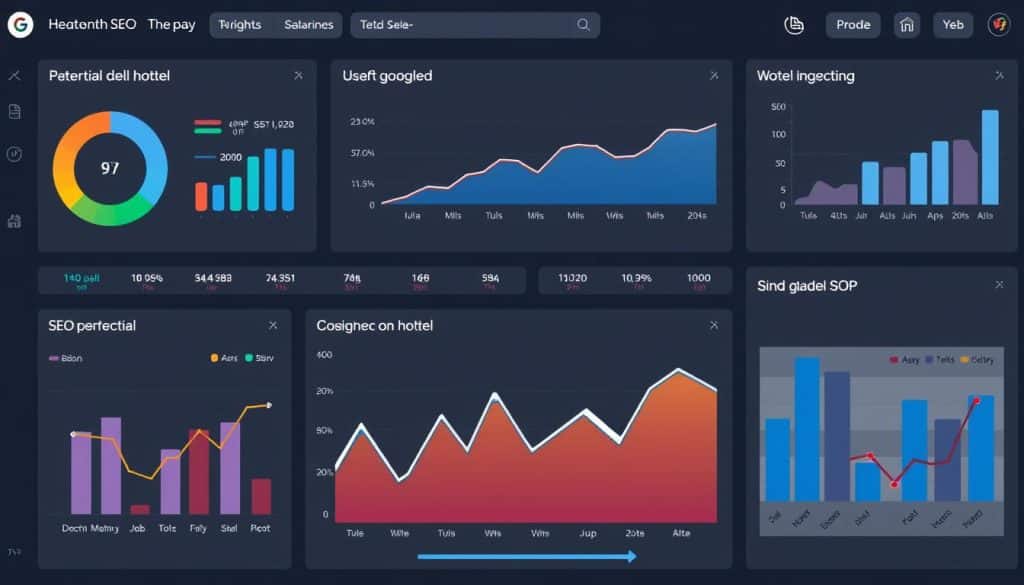
Understanding the impact of SEO on your hotel’s bottom line requires a data-driven approach to tracking performance. To effectively measure the success of your SEO efforts, you need to monitor key metrics that reflect your hotel’s online visibility and booking performance.
Essential SEO Metrics for Hospitality Businesses
For hotels, essential SEO metrics include organic traffic, keyword rankings, conversion rates, booking engine entrances, and revenue attributed to organic search. These metrics provide insights into how well your hotel website is performing in search engines and how effectively it converts visitors into guests.
Using Google Analytics for Hotel Websites
Google Analytics is a powerful tool for understanding user behavior on your hotel website. It helps you track how visitors interact with your site, from the pages they visit to the actions they take. By setting up goal tracking in Google Analytics, you can measure specific conversion actions such as newsletter signups or completed bookings, providing clear ROI measurements.
Combining Google Analytics with Google Search Console provides a comprehensive view of your hotel’s SEO performance, including search-specific data like impressions, click-through rates, and actual search queries that bring visitors to your site.
Common SEO Mistakes in the Hospitality Industry
In the competitive hospitality industry, avoiding common SEO mistakes is crucial for hotels to maintain visibility and attract potential guests. As search engines continue to evolve, hotels must adapt their SEO strategies to stay competitive.
Many hotels make critical errors that hinder their online success. Two of the most significant mistakes are overlooking mobile optimization and neglecting local SEO opportunities.
Overlooking Mobile Optimization
With over 60% of travel searches and 52% of bookings occurring on mobile devices, a mobile-friendly website is no longer optional. Google’s mobile-first indexing prioritizes the mobile version of your site, making it essential for hotels to ensure a seamless user experience across all devices.
- Slow-loading pages
- Difficult navigation
- Tiny buttons that are hard to tap
- Booking forms not optimized for touchscreen input
Neglecting mobile optimization can result in higher bounce rates, lower engagement metrics, and ultimately lost bookings.
| Mobile Optimization Features | Importance | Impact on Bookings |
|---|---|---|
| Responsive Design | High | Increases conversions |
| Fast Loading Speed | High | Reduces bounce rates |
| Easy Navigation | Medium | Improves user experience |
Neglecting Local SEO Opportunities
Local SEO is critical for hospitality businesses, as 76% of people who search for something nearby on their smartphone visit a business within a day. Hotels must optimize their Google Business Profile, build local citations, and create location-specific content to attract local travelers.
Failing to optimize for “near me” searches, which have grown by 900% in recent years, can put hotels at a significant competitive disadvantage.
Conclusion: Implementing a Sustainable SEO Strategy for Long-Term Success
To achieve long-term success in the competitive Qatari hospitality market, hotels must adopt a sustainable SEO approach that aligns with their overall business goals. We believe that a balanced strategy combining technical excellence, quality content creation, and strategic promotion is crucial for driving revenue growth through digital excellence.
A successful hotel SEO strategy is not about achieving quick wins; it’s about building a strong foundation that delivers consistent results and adapts to changing algorithms and market conditions. This begins with thorough research—understanding your target audience, analyzing competitors, and identifying the most valuable keywords and topics for your business.
Prioritizing user experience above all else aligns perfectly with both search engine algorithms and the expectations of potential guests, creating a virtuous cycle of improvement. Technical SEO provides the foundation, content marketing builds the structure, and link building adds authority—all three components must work together for optimal results.
Regular auditing and performance analysis allow you to identify what’s working and what needs adjustment, ensuring your strategy evolves with changing search patterns and algorithms. By building internal SEO capabilities within your team, you ensure continuity and consistent implementation of best practices.
A sustainable SEO strategy recognizes that SEO is not a separate marketing channel but should be integrated with your overall digital marketing strategy, including paid search, social media, and email marketing. By implementing the strategies outlined in this guide and committing to ongoing optimization, your hospitality business can achieve sustainable growth in organic search visibility, direct bookings, and revenue.
As search engines continue to evolve toward understanding user intent and delivering personalized results, hotels that focus on genuinely meeting traveler needs will naturally succeed in SEO. We are confident that by following these guidelines, your hotel can improve its online presence, attract the right visitors, and drive long-term success.
FAQ
How does SEO impact direct bookings for hotels?
By optimizing their website and online presence, hotels can increase their visibility in search engine results, driving more direct bookings and reducing reliance on third-party booking sites.
What makes keyword research essential for hospitality businesses?
Keyword research helps hotels identify relevant search terms and phrases, enabling them to create targeted content that resonates with potential guests and improves their search engine rankings.
How can hotels optimize their website for local search?
Hotels can optimize their website for local search by including location-specific keywords, creating content relevant to their local audience, and ensuring their Google Business Profile is accurate and up-to-date.
What is the importance of mobile-friendliness for hotel websites?
With most travelers using mobile devices to research and book hotels, a mobile-friendly website is crucial for providing a good user experience, improving search engine rankings, and driving bookings.
How can hotels leverage content marketing to attract travelers?
By creating valuable, relevant, and informative content, hotels can attract potential guests, establish their brand as a trusted authority, and drive bookings through their website.
What role does link building play in hotel SEO?
Building high-quality backlinks from relevant sources, such as travel bloggers and local directories, can improve a hotel’s website authority, increase its visibility in search engine results, and drive more traffic to the site.
How can hotels measure the success of their SEO efforts?
Hotels can track key SEO metrics, such as website traffic, search engine rankings, and conversion rates, using tools like Google Analytics to measure the effectiveness of their SEO strategy.
What are some common SEO mistakes hotels should avoid?
Hotels should avoid common SEO mistakes, such as neglecting mobile optimization, ignoring local SEO opportunities, and failing to track their SEO performance, to ensure they maximize their online visibility and drive more bookings.