

Are you ready to unlock the full potential of your online presence in the voice-activated world? With over 50% of internet searches now being voice-activated, the way people find and interact with online content is undergoing a significant transformation.
As more businesses in Qatar and beyond adopt smart speakers and voice features on their mobile devices, the opportunity to capture this growing segment of search traffic has never been more critical.
We will explore how voice search differs from traditional text-based searches and why adapting your SEO approach is crucial for staying ahead in the digital landscape.
Key Takeaways
- Understand the impact of voice search on your online visibility
- Learn how to optimize your content for voice queries
- Discover the importance of natural language optimization
- Find out how to target featured snippets for better results
- Gain insights into the technical aspects of voice search optimization
The Rising Importance of Voice Search in SEO
The rise of voice search is transforming the way businesses approach SEO, making it a critical component of their digital marketing strategy. As voice-activated devices become increasingly popular, businesses must adapt to the changing search landscape to remain competitive.
Current Voice Search Statistics and Trends
Voice search has evolved significantly, with search engines now prioritizing voice-friendly content in their algorithms. Our research indicates that voice search is particularly dominant in mobile contexts, where users are five times more likely to initiate a voice search than type a query while on the go.
- Voice search has become a critical component of the search ecosystem.
- Businesses ignoring voice search optimization risk losing significant visibility.
- Voice search is driving higher conversion rates for businesses that optimize effectively.
| Voice Search Statistics | Percentage/Number |
|---|---|
| Mobile Voice Search Users | 5x more likely to use voice search |
| Conversion Rate Increase | 30% more conversions |
Why Businesses Can’t Ignore Voice Search in 2024
In 2024, businesses that fail to optimize for voice search risk falling behind their competitors. The convenience factor of voice search is changing user expectations, with consumers demanding immediate, accurate responses delivered conversationally.
By prioritizing voice search optimization, businesses can gain a competitive advantage and position themselves as industry leaders. As voice search continues to grow, it’s essential for businesses to future-proof their digital marketing strategy by incorporating voice search optimization.

Understanding How Voice Search Works
The rise of voice search has transformed how we interact with technology, making it essential to comprehend its underlying processes. Voice search allows users to speak their queries, and the technology behind it interprets and processes these queries to deliver relevant results.
To understand the mechanics of voice search, we need to explore the major voice assistants and how they process user queries.
The Major Voice Assistants: Google vs. Siri vs. Alexa
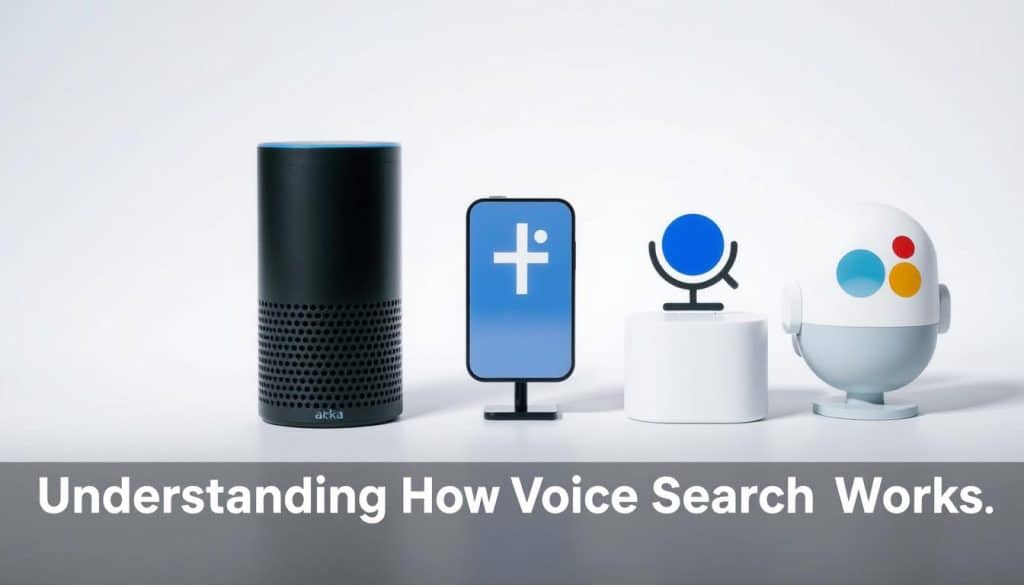
The landscape of voice search is dominated by a few key players: Google Assistant, Siri, and Alexa. Each of these voice assistants has its unique strengths and processing mechanisms. Google Assistant is known for its ability to understand complex queries and provide accurate results. Siri, on the other hand, is deeply integrated with Apple devices, offering a seamless user experience. Alexa, with its wide range of skills, excels in smart home automation and voice shopping.
How Voice Assistants Process and Deliver Results
Voice assistants employ sophisticated natural language processing (NLP) algorithms to interpret user queries. The process involves several critical steps: speech recognition, language understanding, query processing, search execution, and response formulation. Google’s RankBrain, a machine learning component, plays a pivotal role in understanding user intent behind voice queries, categorizing them into informational, navigational, transactional, or actional intents.
- Voice assistants prioritize delivering concise, direct answers rather than lists of search results, making featured snippets and structured data crucial for visibility.
- The contextual understanding capabilities of modern voice assistants allow them to maintain conversation history, enabling follow-up questions without repeating the original query context.
- Response delivery varies by platform – Google Assistant and Siri typically provide a single best answer with the option to see more results, while Alexa may offer multiple options in certain scenarios.
Understanding these processing mechanisms allows us to strategically structure content to align with how voice assistants interpret and prioritize information for delivery to users.
Voice Search vs. Traditional Search: Key Differences
The way we search for information online is changing with the rise of voice search, differing significantly from traditional search methods. As voice technology advances, understanding these differences becomes crucial for businesses aiming to optimize their online presence.
Voice search queries are fundamentally different from typed searches. When using voice search, users tend to employ a more natural, conversational tone.
Conversational Queries vs. Typed Keywords
Unlike traditional typed searches, which often involve fragmented keywords, voice searches are typically full, natural-language queries. For instance, a user might type “best Italian restaurants NYC” into a search engine, but with voice search, they’re more likely to ask, “What are the best Italian restaurants in New York City?” This shift towards conversational queries means businesses must adapt their SEO strategies to accommodate more natural language patterns.

User Intent and Context in Voice Searches
User intent plays a critical role in voice search, with queries often being more immediate and action-oriented. Voice search users frequently seek specific answers or solutions they can act on immediately. Context also plays a much more significant role in voice search, with devices maintaining conversation history to understand follow-up questions without requiring full context repetition.
| Search Type | User Intent | Contextual Understanding |
|---|---|---|
| Voice Search | Immediate, action-oriented | Maintains conversation history |
| Traditional Search | Varies, often informational | Limited contextual understanding |
Understanding these differences is crucial for businesses to optimize their content effectively for voice search. By recognizing the conversational nature of voice queries and the importance of context and user intent, businesses can tailor their SEO strategies to better serve voice search users.
Voice Search SEO Strategies to Boost Your Rankings

To dominate the voice search landscape, businesses must adopt tailored SEO strategies that cater to the nuances of spoken queries. Voice search is changing the way consumers interact with search engines, and companies must adapt to remain competitive.
Optimizing for Natural Language and Conversational Keywords
Optimizing for natural language involves understanding how people speak, not just how they type. Conversational keywords are longer and more complex than traditional keywords, often mirroring the natural flow of speech. To capture voice search traffic, we need to incorporate these conversational phrases into our content.
Tools like AnswerThePublic.com and Ubersuggest can help identify the specific questions and phrases your target audience uses. By analyzing these insights, we can refine our keyword strategy to better match voice search queries.
Focusing on Long-Tail, Question-Based Queries
Long-tail, question-based queries are crucial for effective voice search optimization. These queries are typically 3-5 words longer than text searches and closely mirror the natural patterns of spoken questions. By focusing on these queries, we can increase our chances of appearing in voice search results.
- Use tools like Google’s “People Also Ask” to find relevant questions.
- Mine your customer interaction channels to reveal the exact language patterns your audience uses.
- Structure content around the “who, what, where, when, why, and how” framework to ensure comprehensive coverage.
By implementing these strategies, we can improve our rankings and drive more traffic to our site.
Structuring Content for Voice Search Success
The key to voice search success lies in how you organize and present your content. As voice assistants become increasingly popular, businesses must adapt their content strategies to meet the changing needs of their audience.
To improve your content’s visibility in voice search results, consider the following strategies. We will explore two crucial aspects: creating featured snippet-worthy content and implementing FAQ sections with schema markup.
Creating Featured Snippet-Worthy Content
Featured snippets are a critical component of voice search results, as they provide direct answers to users’ queries. To increase the chances of your content being featured, focus on creating concise, informative, and well-structured content.
Use headers, bulleted or numbered lists, and short paragraphs to make your content easily scannable. By doing so, you can improve your content’s visibility in search results and increase the likelihood of being selected as a featured snippet.
Implementing FAQ Sections with Schema Markup
FAQ sections are an effective way to structure content for voice search, as they directly align with the question-and-answer format used by voice assistants. By implementing FAQ schema markup, you can explicitly identify question-answer pairs for search engines, increasing the likelihood of selection for voice results.
Our testing has shown that properly structured FAQ sections with schema markup can increase voice search visibility by up to 30%. To maximize the effectiveness of your FAQ sections, organize them into logical topic clusters and ensure that your content is concise and directly addresses the user’s query.
Technical Optimization for Voice Search
With the rise of voice search, technical optimization is no longer a nicety, but a necessity for businesses to improve their online visibility. As voice assistants become increasingly popular, ensuring your website is technically sound is crucial for voice search success.
Mobile-First Optimization and Page Speed
Mobile-first optimization is critical for voice search, as most voice searches occur on mobile devices. Page speed is also essential, as slow-loading websites can negatively impact user experience and search engine rankings. To optimize for mobile and page speed, use tools like Google’s PageSpeed Insights to identify areas for improvement.
Some key strategies for mobile-first optimization include:
- Ensuring a responsive design that adapts to different screen sizes
- Optimizing images and compressing files to reduce page load times
- Using mobile-friendly formats for content, such as AMP
Structured Data Implementation
Structured data implementation is a critical technical foundation for voice search success. By providing explicit signals to search engines about content meaning and relationships, structured data helps voice assistants understand and deliver relevant results. We recommend implementing multiple schema types, such as HowTo, FAQ, and LocalBusiness, to enhance voice search visibility.
To implement structured data effectively, use schema markup to highlight key content elements, such as reviews, events, and business hours. Regular testing using Google’s Structured Data Testing Tool ensures that your implementation remains effective as search engines evolve their requirements.
Local SEO and Voice Search: A Perfect Match
The rise of voice search has made local SEO an indispensable strategy for businesses aiming to boost their online presence. As voice assistants become increasingly popular, optimizing for local search has become crucial for businesses to remain competitive.
Local SEO is particularly important for voice search because most voice queries are location-based. Ensuring your business is visible in local search results can significantly impact your bottom line.
Optimizing for “Near Me” Searches
“Near me” searches have become a staple of voice queries, with users often asking voice assistants to find businesses or services nearby. To optimize for these searches, businesses must ensure their Google Business Profile is accurate, complete, and up-to-date.
This includes providing precise location information, business hours, and categories. By doing so, businesses can increase their chances of appearing in voice search results for “near me” queries.
Google Business Profile Optimization for Voice Queries
Google Business Profile optimization serves as the cornerstone of local voice search visibility, with properly optimized listings appearing in up to 70% of local voice search results.
To optimize your Google Business Profile for voice queries, focus on the following key areas:
- Complete and Accurate Information: Ensure your business information is comprehensive and accurate, including your business description, hours, and categories.
- Natural Language Patterns: Optimize your business description using natural language patterns that match common voice queries.
- Regular Updates: Regularly update your Google Business Profile with fresh content, including posts, photos, and offers, as recency signals influence voice search selection.
- Customer Reviews: Encourage and respond to customer reviews, as they not only improve local search rankings but also provide valuable content that voice assistants may reference.
By implementing these strategies, businesses can significantly improve their visibility in voice search results, driving more local traffic and sales.
Content Creation Strategies for Voice Search
The rise of voice search has transformed the way we approach SEO, with a greater emphasis on conversational content and multimedia optimization. As voice assistants become increasingly prevalent, businesses must adapt their content strategies to meet the changing needs of their audience.
Creating Conversational and Readable Content
To optimize for voice search, it’s essential to create content that is conversational, readable, and easily digestible by voice assistants. We focus on using natural language patterns and long-tail keywords that reflect how users speak. By doing so, we increase the likelihood of our content being featured in voice search results.
Our approach involves crafting content that directly answers user queries, often in a question-and-answer format. This not only improves voice search visibility but also enhances the overall user experience. For more insights on creating effective SEO strategies, visit our page on SEO website design solutions.
Video and Multimedia Optimization for Voice Search
Video content plays a crucial role in voice search optimization, as search engines prioritize direct, easy-to-follow answers. We optimize video content by using comprehensive, conversational titles and descriptions that incorporate natural language patterns. Additionally, implementing video schema markup and creating dedicated video transcripts significantly improves the likelihood of video content selection for relevant voice queries.
By hosting videos on YouTube while embedding them on our site, we create dual optimization opportunities, leveraging both YouTube’s strong voice search presence and our website’s domain authority. Strategic multimedia integration, combining video, audio, and text content addressing the same topics, creates multiple pathways for voice search discovery.
Measuring Voice Search SEO Success
In the realm of voice search SEO, success is not just about visibility, but about measuring the right metrics to drive results. To effectively gauge our performance, we need to leverage the right tools and strategies.
Key Metrics to Track
To understand the impact of voice search on our SEO efforts, we need to focus on specific metrics. These include tracking featured snippet acquisition, monitoring question-based keyword rankings, and analyzing local search performance. By doing so, we can refine our SEO strategy to better align with voice search trends.
Key metrics to focus on include:
- Featured snippet rankings
- Question-based query performance
- Local search visibility
- Voice search-driven traffic patterns
Tools for Voice Search Analytics
Specialized analytics tools are crucial for measuring voice search performance. We recommend using AI-powered SEO platforms like SEMrush, Ahrefs, and Moz to track our performance. Additionally, tools like Clearscope and SurferSEO provide valuable insights into optimizing content for voice search patterns.
Other essential tools include:
- Google Search Console for identifying question-based queries
- BrightLocal and Whitespark for local voice search performance
- Structured data testing tools for schema markup effectiveness
- Custom Google Analytics segments for identifying voice search traffic patterns
For more insights on optimizing website content for voice search, visit this LinkedIn article.
Future Trends in Voice Search Optimization
As voice search technology advances, it’s crucial to stay ahead of the curve by understanding the future trends that will shape the industry. Optimizing for voice assistants in SEO ensures that our content aligns with how users interact with technology today.
AI and Machine Learning Developments
The next generation of voice search will be characterized by deeper integration into everyday devices beyond smartphones and smart speakers, including appliances, vehicles, and wearable technology. Multimodal interactions will become the standard, combining voice with touch, gesture, and visual inputs. This shift requires more sophisticated optimization approaches, including the use of AI-driven tools to analyze and adapt to new voice search contexts.
Our research indicates that voice commerce will become increasingly frictionless, with voice assistants facilitating seamless purchasing experiences directly through voice commands. To capitalize on this trend, businesses must develop voice-specific content strategies that anticipate user needs across different contexts and devices.
Preparing for the Next Generation of Voice Search
To prepare for the advancements in voice search, we recommend building flexible content architectures that can adapt to new voice search contexts and delivery mechanisms. Privacy considerations will become increasingly important as voice search becomes more personalized, requiring transparent data practices and user-controlled personalization options.
Establishing a brand’s unique voice and tone will become a competitive advantage as voice interactions become more conversational and personality-driven. As quoted by a leading expert, “The future of voice search is not just about technology; it’s about creating a more human experience.” We must focus on developing a distinct brand voice that resonates with our target audience.

Conclusion
In the evolving digital landscape, optimizing for voice search is no longer a choice but a necessity for businesses aiming to stay competitive. As we’ve explored throughout this guide, effective voice search SEO strategies require a multifaceted approach that encompasses content creation, technical optimization, and continuous measurement.
By focusing on conversational keywords and ensuring mobile optimization, businesses can significantly improve their visibility in voice search results. Our research has shown that companies implementing voice search optimization are experiencing measurable improvements in visibility, traffic, and conversions across both voice and traditional search channels.
The convergence of voice search with local SEO presents particularly valuable opportunities for businesses with physical locations. To capitalize on this trend, we recommend starting your voice search optimization journey by conducting a comprehensive audit of your current content and identifying opportunities to restructure existing assets for voice visibility. For more insights into the future of voice search, you can read our analysis on what role voice search optimization will play in 2025 SEO.
By implementing these strategies, you’ll not only enhance your voice search performance but also improve your overall user experience, creating content that better serves both search engines and human visitors.
FAQ
What is the importance of optimizing for voice search?
Optimizing for voice search allows businesses to stay competitive in the digital landscape, as more users rely on voice assistants to find information and make purchases.
How do voice assistants process and deliver results?
Voice assistants use complex algorithms to understand the context and intent behind a user’s query, and then provide relevant results based on various factors, including structured data and long-tail keywords.
What is the difference between conversational queries and typed keywords?
Conversational queries are typically longer and more natural, as users speak to voice assistants in a more relaxed tone, whereas typed keywords are often shorter and more concise.
How can I optimize my content for featured snippets?
To optimize for featured snippets, focus on creating high-quality, informative content that directly answers a user’s question, and use schema markup to help Google Assistant understand the context.
What is the role of long-tail keywords in voice search optimization?
Long-tail keywords play a crucial role in voice search optimization, as they help businesses target specific user queries and increase their chances of appearing in search results.
How can I measure the success of my voice search optimization efforts?
To measure the success of your voice search optimization efforts, track key metrics such as website traffic, engagement, and conversion rates, and use tools like Google Analytics to monitor your performance.
What is the impact of mobile-first optimization on voice search?
A mobile-first optimization strategy is essential for voice search, as most users access voice assistants through their mobile devices, and a fast, responsive website is critical for a good user experience.
How can I optimize my business for "near me" searches?
To optimize for “near me” searches, ensure your business listing is accurate and up-to-date on Google Business Profile, and use location-specific keywords to help voice assistants understand your business’s relevance to a user’s query.