
In Qatar’s rapidly evolving digital landscape, a staggering 75% of consumers use search engines to find local businesses online. This statistic underscores the critical importance of having a professional online presence that is both visually appealing and optimized for search engines.
At our company, we understand that building a successful website requires striking a delicate balance between catering to consumer needs and search engine requirements. Our team of experts excels at creating professional website design and SEO services that not only captivate your target audience but also improve your search engine rankings.
By integrating cutting-edge design principles with proven SEO strategies, we help businesses in Qatar establish a robust online presence that drives results.
Key Takeaways
- Discover how our comprehensive approach can transform your business presence in Qatar’s competitive digital landscape.
- Learn why integrating design and search optimization is crucial for success in today’s online marketplace.
- Understand how our data-driven methodology ensures your website performs effectively in search rankings.
- Find out how proper website structure and content optimization can significantly impact your business visibility.
- Gain insights into creating a website that balances visual appeal with technical SEO elements.
The Digital Landscape in Qatar: Why Website Design and SEO Matter
In Qatar’s rapidly evolving digital landscape, a well-designed website and effective SEO strategy are crucial for businesses to stay competitive. As the country’s online market continues to grow, local businesses are recognizing the importance of establishing a strong online presence.
Growing Online Market
The online market in Qatar is expanding rapidly, driven by increasing internet penetration and a tech-savvy population. SEO web design is emerging as a key factor in helping businesses reach their target audience effectively. Our data indicates that consumers in Qatar are increasingly researching local businesses online before making purchasing decisions, making search visibility critical.
| Year | Internet Penetration Rate | Online Shopping Growth |
|---|---|---|
| 2020 | 95% | 20% |
| 2021 | 96% | 25% |
| 2022 | 97% | 30% |
Benefits for Local Businesses
Local businesses in Qatar can significantly benefit from a strong online presence. By investing in professional website design and SEO services, businesses can expand their reach beyond traditional geographic limitations. Our approach helps Qatar businesses leverage their unique local knowledge and expertise while expanding their digital footprint. We’ve helped numerous Qatar-based businesses transform their market position through strategic website design and SEO implementation.

Through targeted content strategies, local businesses can establish authority in their specific niches and attract high-intent traffic. We’ve identified that businesses with strong SEO strategies can effectively compete with larger international companies in the Qatar market. By prioritizing SEO and web design, businesses can drive revenue growth and maintain a competitive edge in Qatar’s evolving digital landscape.
Understanding Website Design and SEO Integration
To maximize online visibility and user engagement, Qatar businesses must strike a balance between creative website design and effective SEO strategies. This balance is crucial because, on one hand, a well-designed website provides a great user experience, while on the other hand, a website optimized for search engines improves its visibility and drives more traffic.
Balancing Creativity and Search Engine Requirements
Finding the right balance between being user-friendly and SEO-friendly can be challenging due to conflicting recommendations from design and SEO teams. Search engine optimization (SEO) involves various tactics, including strategic keyword research, to improve a website’s ranking on search engine results pages (SERPs). Meanwhile, website design focuses on creating a visually appealing and user-friendly interface. Our integrated approach ensures that both aspects are considered simultaneously, resulting in a website that is both aesthetically pleasing and optimized for search engines.
The Challenges of Separate Design and SEO Teams
Many Qatar businesses struggle with siloed approaches where design and SEO teams work independently, creating inefficiencies. Our experience has shown that when these teams work together, they can deliver more cohesive websites that perform better in both user engagement and search rankings. By eliminating the common conflicts between creative design priorities and technical SEO requirements, we can create a unified digital strategy that benefits your overall business goals.
Some key benefits of our integrated approach include:
- Eliminating conflicts between creative design priorities and technical SEO requirements
- Developing collaborative workflows that address both design and SEO considerations simultaneously
- Delivering more cohesive websites that perform better in user engagement and search rankings
- Bridging the knowledge gap between design and SEO specialists to create synergies that benefit your overall digital strategy
Key Elements of SEO-Friendly Web Design
Creating an SEO-friendly website requires a harmonious blend of design and search engine optimization techniques. A well-crafted website not only appeals to users but also ranks higher in search engine results, driving more traffic and potential customers to your site.
Site Structure and Navigation Optimization
A well-organized site structure and intuitive navigation are crucial for both users and search engines. We ensure that your website’s architecture is logical and easy to follow, making it simpler for visitors to find the information they need and for search engines to crawl and index your pages effectively.
Effective site structure and navigation optimization involve creating a clear hierarchy of pages, using descriptive labels for categories and subcategories, and implementing breadcrumb navigation to enhance user experience.
URL Structure and Metadata Implementation
Optimizing your website’s URL structure and metadata is vital for improving search engine rankings. We create descriptive, keyword-rich URLs that accurately reflect the content of each page, making it easier for search engines to understand your site’s structure.
Metadata, including title tags and meta descriptions, provides search engines with crucial information about your pages. We craft compelling and informative metadata that not only improves search engine rankings but also entices users to click through to your site.
Internal Linking Strategies
Internal linking is a powerful tool for enhancing user experience and improving search engine rankings. By creating a strategic internal linking architecture, we help distribute page authority throughout your site, guide users through related content, and signal content relationships to search engines.
Our internal linking strategies include creating logical pathways for users, using contextual anchor text to provide clear signals about destination page content, and regularly auditing and updating internal linking structures to reflect new content and changing business priorities.
| Internal Linking Strategy | Description | Benefits |
|---|---|---|
| Strategic Internal Linking Architecture | Distributes page authority throughout the site | Enhances user navigation and search engine understanding |
| Contextual Anchor Text | Provides clear signals about destination page content | Improves user experience and search engine rankings |
| Regular Auditing and Updates | Reflects new content and changing business priorities | Maintains optimal internal linking structure |

Mobile Optimization: A Critical Factor for Qatar Businesses

With the majority of online searches now conducted on mobile devices, Qatar businesses must prioritize mobile optimization to improve their search engine rankings and stay competitive in the digital landscape.
Mobile Usage Statistics in Qatar
Mobile device penetration in Qatar is among the highest in the region, with a significant portion of the population using smartphones to access the internet. This trend underscores the importance of having a mobile-friendly website that caters to the needs of these users.
Responsive Design Best Practices
To ensure a seamless user experience across various devices, we implement responsive design principles. This approach allows us to create websites that adapt to different screen sizes and orientations, ensuring that content is easily accessible on mobile devices.
Mobile-First Indexing Considerations
As Google continues to prioritize mobile-first indexing, it’s crucial for Qatar businesses to ensure that their website’s mobile version contains all the content and structured data present on the desktop version. We achieve this by implementing technical solutions that maintain fast loading speeds on mobile devices without sacrificing content quality.
Our approach to mobile optimization includes several key strategies:- We design with Google’s mobile-first indexing principles as a foundational consideration for all Qatar business websites.- Our approach ensures that mobile versions of your site contain all the content and structured data present on desktop versions.- We implement technical solutions that maintain fast loading speeds on mobile devices without sacrificing content quality.- Our mobile-first strategy ensures that all critical business information is easily accessible on mobile versions of your site.- We optimize mobile layouts to prioritize the most important content and conversion elements for smaller screens.- Our mobile indexing considerations include proper handling of expandable content sections to ensure all content is properly indexed.- We implement mobile-specific schema markup to enhance search visibility for Qatar businesses in mobile search results.
Website Speed and Performance Optimization

Website speed and performance optimization is no longer a luxury, but a necessity for businesses operating in Qatar’s growing online market. A fast and optimized website not only enhances user experience but also significantly impacts search engine rankings and conversion rates.
Impact on Rankings and Conversions
Page speed is a critical ranking factor, as confirmed by Google. A slow website can lead to higher bounce rates, negatively affecting both rankings and conversions. Studies have shown that a one-second delay in page load time can result in a 7% reduction in conversions. By optimizing website speed, businesses in Qatar can improve their search engine rankings, drive more traffic, and ultimately increase conversions.
Common Speed Issues and Solutions
Common issues affecting website speed include large image sizes, unoptimized code, and excessive HTTP requests. To address these, we employ image compression, minify CSS and JavaScript files, and implement browser caching. Our approach ensures that Qatar businesses can enjoy faster, more efficient websites that provide a better user experience.
- We utilize a comprehensive suite of performance measurement tools to establish baselines and track improvements for Qatar business websites.
- Our performance optimization process employs both lab data and real user metrics to identify the most impactful areas for improvement.
Tools to Measure and Improve Performance
To measure and improve website performance, we use tools like Google PageSpeed Insights, GTmetrix, and WebPageTest. These tools provide multi-dimensional performance analysis, helping us identify areas for improvement. By leveraging these tools, we can optimize website performance, ensuring that Qatar businesses achieve better search engine rankings and improved user engagement.
Our approach includes continuous monitoring tools that alert us to performance degradation before it impacts your business results. We also utilize browser developer tools to identify specific code-level optimizations that can improve rendering performance.
Content Optimization for Qatar Audiences
Optimizing content for the Qatari audience requires a deep understanding of local preferences and search behaviors. As the digital landscape in Qatar continues to evolve, businesses must adapt their content strategies to effectively engage their target audience.
Creating Localized, Relevant Content
Creating content that resonates with Qatari users involves more than just translation. It requires a nuanced understanding of cultural and linguistic nuances. We develop content that is not only linguistically accurate but also culturally relevant, ensuring that it meets the specific needs and preferences of the Qatari market. By doing so, we enhance user experience and improve engagement.
Keyword Research for Qatar Market
Effective keyword research is crucial for understanding what Qatari users are searching for online. We conduct thorough keyword research to identify relevant terms and phrases that align with your business goals and target audience. This involves analyzing search trends, competitor strategies, and user behavior to inform our content optimization efforts.
Content Hierarchy and Readability
A well-structured content hierarchy is essential for both user experience and SEO. We implement clear content hierarchies that guide users and search engines through your information architecture. This includes using proper heading hierarchies (H1-H6) to create visual organization and semantic structure, optimizing readability through font selection, size, contrast, and spacing, and incorporating strategic use of bullet points and short paragraphs to enhance scannability.
By focusing on these aspects, we ensure that your content is not only optimized for search engines but also provides a superior user experience, ultimately driving engagement and conversions in the Qatari market.
Technical SEO Aspects for Effective Website Design
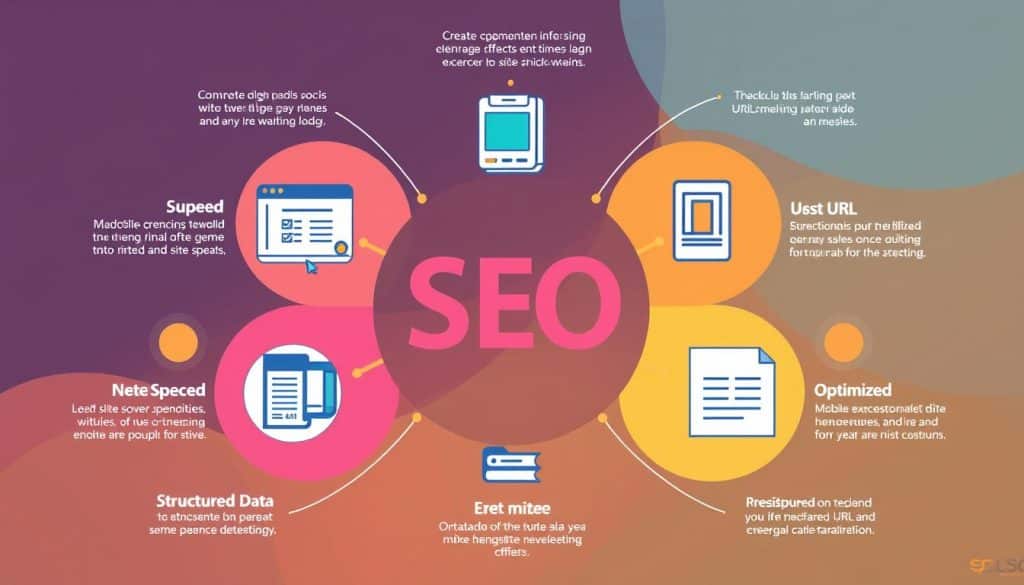
Technical SEO plays a crucial role in creating a website that is both visually appealing and search engine friendly. It involves several behind-the-scenes elements that are crucial for a website’s performance and search engine ranking.
XML Sitemaps and Robots.txt Configuration
Proper configuration of XML sitemaps and robots.txt files is essential for helping search engines understand and crawl a website effectively. An XML sitemap acts as a map of the website, guiding search engines to important pages. Meanwhile, the robots.txt file instructs search engines on which pages to crawl and which to avoid. For instance, we can use the robots.txt file to prevent search engines from indexing duplicate or irrelevant pages, thus optimizing the crawl process. To learn more about the importance of technical SEO in website design, visit this resource.
Schema Markup for Enhanced Search Results
Schema markup is a form of microdata that helps search engines understand the context of the content on a website. By implementing schema markup, websites can enhance their search engine results with rich snippets, which can improve click-through rates. For example, a website selling products can use schema markup to display product reviews, prices, and availability directly in search results, making it more attractive to potential customers.
SSL Implementation and Security Considerations
Implementing SSL (Secure Sockets Layer) is critical for securing a website and protecting user data. We ensure robust SSL security by configuring HTTPS correctly, redirecting HTTP traffic to HTTPS, and ensuring all resources load securely. This not only protects against data breaches but also boosts trust with both users and search engines. Our approach includes regular monitoring for potential vulnerabilities and swift remediation when needed, ensuring the website remains secure and performs optimally.
By focusing on these technical SEO aspects, businesses can significantly improve their website’s visibility, security, and overall performance, leading to better search engine rankings and a more satisfying user experience.
User Experience (UX) and Its Impact on SEO
User experience (UX) plays a crucial role in determining the success of a website, directly impacting its SEO performance. A well-crafted UX design not only enhances user engagement but also improves search engine rankings. We understand that a positive user experience is key to driving conversions and increasing website traffic.
Navigation and Site Structure Best Practices
Effective navigation and site structure are critical elements of UX design that significantly impact SEO. We implement intuitive navigation menus and organize content in a logical manner to facilitate easy access to information. This approach not only improves user satisfaction but also helps search engines understand the site’s hierarchy and content relevance. By optimizing site structure, we can enhance crawlability and indexing, leading to better search engine rankings.
Reducing Bounce Rates Through Design
Design plays a vital role in reducing bounce rates and increasing user engagement. We focus on creating visually appealing and responsive designs that adapt to various devices and screen sizes. By ensuring that websites load quickly and are easy to navigate, we can reduce bounce rates and improve overall user experience. Our approach includes optimizing images, leveraging browser caching, and minimizing code to achieve faster page loads.
Accessibility Considerations for All Users
Accessibility is a crucial aspect of UX design that is often overlooked. We prioritize accessibility by implementing features that ensure our websites are usable by all visitors, regardless of their abilities. This includes providing alt text for images, using descriptive text for links and form inputs, and ensuring keyboard navigability. By following WCAG guidelines, we create inclusive experiences that benefit both users and SEO performance.
- Implementing comprehensive accessibility features to ensure usability for all visitors.
- Following WCAG guidelines to create inclusive experiences that benefit SEO performance.
- Ensuring proper color contrast ratios and text sizing for improved readability.
- Creating keyboard-navigable interfaces for users who cannot use a mouse or touch screen.
Measuring Success: Analytics and Reporting
The true value of your website design and SEO efforts can only be understood by closely examining key performance metrics. By regularly reviewing these analytics, you can identify areas for improvement, measure the impact of design changes, and make data-driven decisions to optimize your site.
Key Metrics to Track for SEO Performance
To gauge the effectiveness of your SEO strategy, focus on metrics such as organic traffic, search engine rankings, and page load times. These indicators provide insights into how well your site is performing in search results and how users are interacting with it.
Tools for Monitoring Website Design Effectiveness
Utilize tools like Google Analytics to monitor user behavior, track conversions, and analyze the overall user experience on your site. These insights are crucial for refining your website design to better meet user needs.
Interpreting Data to Drive Continuous Improvement
We transform raw analytics data into actionable insights that drive continuous improvement for your Qatar business website. Our data interpretation process identifies patterns and trends, prioritizes optimization opportunities, and ensures that data insights are translated into practical actions.
Conclusion: Implementing Professional Website Design and SEO in Qatar
As we’ve explored, integrating website design and SEO is key to driving business growth in Qatar. The digital landscape in Qatar is competitive, and a well-designed, SEO-friendly website is crucial for standing out.
Our comprehensive services are tailored to the unique needs of Qatar businesses, ensuring that design and SEO work together seamlessly. By combining technical expertise with creative excellence, we deliver websites that perform exceptionally well for both users and search engines.
To achieve success, it’s essential to bridge the gap between web development and SEO from the outset. This integrated approach enables businesses to provide value to their customers while improving their search results. By optimizing key elements, creating quality content, and designing top-tier user experiences, businesses can significantly enhance their online presence.
Our commitment to excellence has helped numerous Qatar businesses transform their digital presence and achieve significant growth. We continue to provide ongoing support and optimization to ensure that our clients’ websites remain competitive as search algorithms and user expectations evolve.
FAQ
What is the importance of having a mobile-friendly website for businesses in Qatar?
With the majority of internet users in Qatar accessing the web through mobile devices, a mobile-friendly website is crucial for providing a good user experience, improving search engine rankings, and driving conversions.
How does site structure impact search engine optimization?
A well-organized site structure helps search engines understand the hierarchy and content of a website, making it easier for users to find relevant information and improving the website’s visibility in search results.
What role does content hierarchy play in enhancing readability and SEO?
A clear content hierarchy, achieved through the use of headings and subheadings, improves the readability of a webpage, making it easier for users to scan and understand the content, while also helping search engines identify key topics and keywords.
How can businesses in Qatar optimize their website’s speed and performance?
To optimize website speed, businesses can leverage techniques such as image compression, code minification, and browser caching, while also utilizing tools like Google PageSpeed Insights to identify areas for improvement.
What are the benefits of implementing schema markup on a website?
Schema markup provides search engines with additional context about a website’s content, enabling enhanced search results, such as rich snippets, and improving the overall visibility and click-through rates of a website.
How does user experience impact search engine optimization?
A positive user experience, achieved through intuitive navigation, clear content, and responsive design, can lead to improved engagement, reduced bounce rates, and increased conversions, all of which are factors that search engines consider when ranking websites.
What are the key metrics to track for measuring SEO performance?
Key metrics for measuring SEO performance include organic traffic, keyword rankings, click-through rates, and conversion rates, which provide insights into a website’s visibility, relevance, and overall effectiveness.
How can businesses in Qatar create localized and relevant content?
To create localized content, businesses should conduct thorough keyword research, understand their target audience’s needs and preferences, and develop content that addresses their concerns, while also incorporating local nuances and cultural sensitivities.