

With over 400,000 manual penalties issued by Google every month, the threat to your website’s performance is real. A Google penalty can drastically reduce your online presence, wiping out years of SEO efforts overnight.
Understanding the different types of penalties and their causes is crucial for both prevention and recovery. Whether you’re dealing with a manual action or an algorithmic penalty, the impact on your website’s traffic and visibility can be devastating.
Our comprehensive guide will walk you through everything you need to know about Google penalties – from identification to recovery and future prevention. We’ll explore actionable strategies to help businesses regain their search presence and maintain a penalty-free website.
Key Takeaways
- Understand the causes and effects of Google penalties on your website’s visibility.
- Learn how to identify manual and algorithmic penalties.
- Discover strategies for recovering from Google penalties.
- Implement preventive measures to avoid future penalties.
- Optimize your website’s SEO to maintain a strong online presence.
Understanding Google Penalties
Google penalties can significantly impact a website’s visibility, making it essential to comprehend their nature and implications. Google penalties are actions taken against websites that violate Google’s webmaster guidelines. These penalties can be either manual, applied by human reviewers, or algorithmic, automatically applied through Google’s algorithms.
What Are Google Penalties?
Google penalties are specific actions taken by Google that negatively impact a site’s search rankings and visibility. These penalties serve as Google’s way of enforcing their quality guidelines and maintaining the integrity of their search engine results. There are two primary types of penalties: manual and algorithmic. Manual penalties are applied by human reviewers from Google’s search quality or webspam team after they determine a site violates Google’s guidelines.
Algorithmic penalties, on the other hand, are automatically triggered when Google’s algorithms detect patterns that suggest manipulation or poor user experience. Understanding the distinction between manual and algorithmic penalties is crucial, as the recovery process differs significantly between the two.
Why Google Implements Penalties
Google implements penalties to ensure their users receive high-quality, relevant search results rather than manipulated or low-value content. The search engine giant is committed to providing the best possible answers to search queries, which means penalizing sites that attempt to game the system. By doing so, Google maintains the trust and reliability of its search engine, ensuring a positive experience for its users.
Google’s penalties have evolved over time to become more sophisticated at detecting various forms of manipulation and low-quality content. This evolution underscores Google’s commitment to improving its search engine and providing a better experience for its users.
Types of Google Penalties
Google penalties can significantly impact a website’s visibility and credibility in search engine results. The types of Google penalties vary, and understanding these differences is crucial for recovery and maintaining a healthy online presence.
Manual Actions vs. Algorithmic Penalties
Google penalties fall into two primary categories: manual actions and algorithmic penalties. Manual actions are applied by human reviewers and communicated through Google Search Console. These actions occur when a reviewer determines that pages on a site violate Google’s webmaster quality guidelines. On the other hand, algorithmic penalties are automatically applied through algorithm updates like Panda and Penguin, detecting patterns that suggest manipulation or poor quality.
As stated by Google’s guidelines, “Manual actions are taken when a human reviewer at Google determines that pages on your site violate our webmaster quality guidelines.” This emphasizes the importance of adhering to Google’s guidelines to avoid manual penalties.
Severity Levels: URL, Partial, and Site-wide Penalties
The severity of penalties varies significantly, affecting different levels of a website. Penalties can target a single URL, a section of a site, or an entire domain. For instance, URL-level penalties affect specific problematic pages, while partial penalties impact sections of a website with similar issues. Site-wide penalties are the most severe, potentially removing an entire domain from search engine results.
| Penalty Level | Description | Impact |
|---|---|---|
| URL-level | Affects specific problematic pages | Limited to individual URLs |
| Partial | Impacts sections of a website with similar issues | Affects specific sections or directories |
| Site-wide | Affects the entire domain | Can remove the entire site from search results |
Duration of Penalties
The duration of Google penalties depends on both the severity of the violation and how quickly and thoroughly the underlying issues are addressed. Manual penalties typically require a reconsideration request after fixing the problems, while algorithmic penalties may resolve automatically after the next algorithm refresh. Understanding the nature of the penalty is crucial for developing an effective recovery strategy.
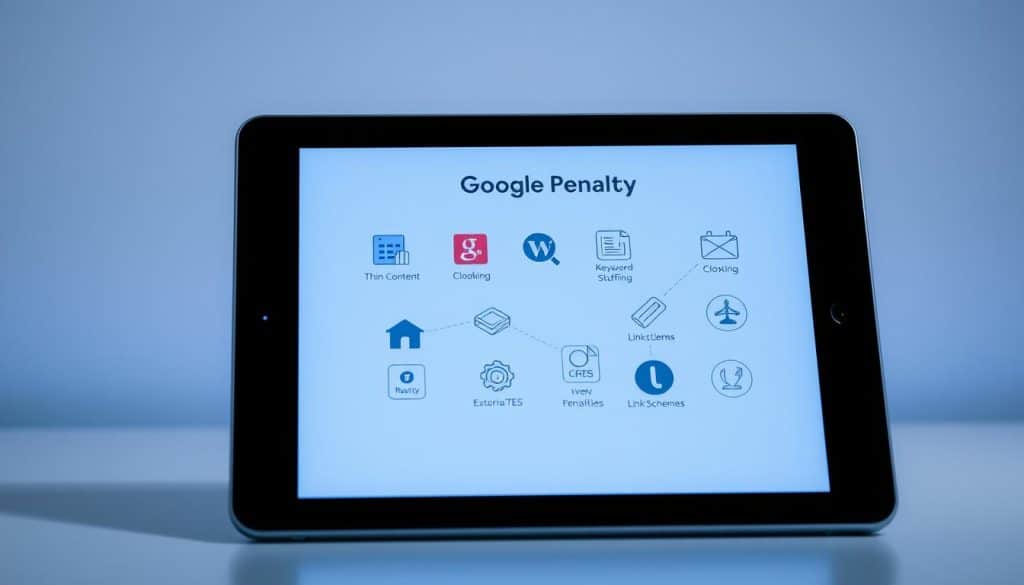
As noted by industry experts, “Understanding which type of penalty has affected your site is the crucial first step in developing an effective recovery strategy.” This highlights the importance of identifying the penalty type to devise a suitable recovery plan.
Major Google Algorithm Updates That Cause Penalties
Navigating the complexities of Google’s algorithm updates is vital for businesses aiming to maintain a strong online presence and avoid search engine penalties. Google’s search algorithm is constantly evolving, with significant updates that can drastically alter a website’s visibility and ranking.
Google Panda: Content Quality Penalties
Launched in 2011, Google Panda targets content-related issues, penalizing sites with thin, duplicate, or low-value content. Websites with excessive advertising or poor content-to-ad ratios are particularly vulnerable. Panda aims to promote high-quality content, ensuring users receive valuable information. To avoid Panda penalties, focus on creating unique, engaging, and relevant content that adds value to your audience.
Google Penguin: Link-Related Penalties
Introduced in 2012, Google Penguin focuses on link-related violations, targeting manipulative link building practices that artificially boost rankings. Penguin penalties can be devastating, with some businesses losing up to 80% of their organic traffic. To mitigate this risk, adopt white-hat SEO practices, such as earning links from authoritative sources and avoiding link schemes. For more insights on recovering from link-related penalties, visit our guide on recovering from Google penalties.
Other Significant Algorithm Updates
Beyond Panda and Penguin, Google has implemented several other significant updates, including BERT and Core Web Vitals. BERT improved Google’s understanding of natural language, penalizing content written for search engines rather than users. Core Web Vitals introduced user experience metrics as ranking factors, potentially penalizing sites with poor loading speeds, visual stability, and interactivity. Staying informed about these updates is crucial, as Google typically doesn’t provide specific details about algorithm changes. For expert guidance on navigating these updates and elevating your online presence, explore our resources on SEO mastery.

Understanding these major algorithm updates is crucial for diagnosing the cause of traffic drops and implementing the appropriate recovery strategies. By staying informed and adapting to these changes, businesses can better protect their online presence and maintain a competitive edge in search engine rankings.
Common Google Penalties and Their Causes
Google penalties can significantly impact a website’s visibility and credibility, making it crucial to understand the common causes behind these penalties. Google’s algorithms and manual reviewers are designed to ensure that websites provide value to users, and any attempts to manipulate search rankings can result in penalties.
Unnatural Links and Link Schemes
Unnatural links and link schemes are among the most common causes of Google penalties. Practices such as buying links, participating in excessive link exchanges, or using automated programs to create links can lead to penalties. Google’s algorithms have become increasingly sophisticated at detecting artificial link patterns that attempt to manipulate PageRank. To avoid penalties, it’s essential to focus on creating high-quality content that naturally attracts links from authoritative sources.
Thin or Duplicate Content
Thin content penalties target pages that offer minimal value to users, including automatically generated content, doorway pages, and content that’s too brief to satisfy user intent. Duplicate content issues arise when substantial blocks of content appear on multiple pages either within your site or across different domains, confusing search engines about which version to index and rank. Ensuring that your content is unique, informative, and provides value to users is crucial in avoiding these penalties.
Keyword Stuffing and Over-Optimization
Keyword stuffing, once a common SEO tactic, now triggers penalties when keywords are unnaturally forced into content at high densities or in ways that disrupt readability. Over-optimization penalties occur when SEO efforts become too obvious or aggressive, including excessive exact-match anchor text or unnatural keyword placement in headings and meta tags. A balanced approach to SEO, focusing on natural language and user experience, is key to avoiding these issues.
Cloaking and Sneaky Redirects
Cloaking and sneaky redirects attempt to show different content to search engines than to users, a practice Google explicitly prohibits and actively penalizes. Hidden text or links, another deceptive practice, involves placing content that’s visible to search engines but not to users, often through matching text and background colors. User-generated spam, particularly in comments or forums, can also trigger penalties if not properly moderated. Understanding these common penalties helps website owners identify potential issues before they trigger Google’s algorithmic or manual actions.

By understanding the common causes of Google penalties, website owners can take proactive steps to avoid these issues and maintain a healthy online presence. Regular audits and a focus on creating high-quality, user-centric content are essential strategies in preventing Google penalties.
How to Identify If You’ve Been Hit by a Google Penalty
Understanding whether your site has been penalized by Google is essential for maintaining its online presence. A Google penalty can significantly affect your website’s traffic and search rankings, making it crucial to identify and address the issue promptly.
Monitoring Traffic Drops in Google Analytics
Sudden and significant drops in organic traffic are often the first indication of a Google penalty. Use Google Analytics to monitor traffic patterns and pinpoint when the decline began. This tool provides valuable insights into which pages were most affected, helping you understand the scope of the issue.
Checking Manual Actions in Google Search Console
Google Search Console is a critical tool for identifying manual penalties. Check the “Security & Manual Actions” section for any notifications about manual actions taken against your site. These actions are explicitly communicated, providing detailed information about the specific violation and affected pages.
Using Penalty Checker Tools
Specialized tools like Barracuda’s Panguin can help identify correlations between traffic drops and algorithm updates. These tools integrate with Google Analytics to visualize traffic patterns alongside algorithm update timelines, aiding in the detection of algorithmic penalties.
To effectively identify a Google penalty, it’s essential to examine both site-wide metrics and page-level data. A comprehensive technical SEO audit can reveal underlying issues that may have triggered the penalty, such as problematic backlink profiles or content quality issues. By combining data from Google Analytics, Google Search Console, and penalty checker tools, you can determine the scope and severity of the impact and begin the recovery process.

The Impact of Google Penalties on Your Website
Google penalties have far-reaching consequences for websites, affecting not just their search rankings but their overall business health. When a website is penalized, the impact is felt across various aspects of its online presence.
Traffic and Ranking Losses
A Google penalty can lead to significant losses in organic traffic and search engine rankings. Businesses may see their traffic drop by as much as 50-80% overnight, as was the case with Expedia and Rap Genius, which suffered substantial losses following penalties. The loss in rankings isn’t limited to primary keywords; even branded searches can be affected, making it challenging for customers to find the website.
Some key statistics highlighting the impact include:
- Traffic losses ranging from 30% to 90% depending on the penalty’s severity.
- Ranking losses affecting both primary and branded searches.
Business and Revenue Consequences
The consequences of a Google penalty extend beyond traffic and rankings, directly impacting a business’s bottom line. Lead generation, sales, and revenue streams that depend on organic search visibility are all affected. For e-commerce businesses, penalties during peak selling seasons can be particularly devastating, potentially causing irreparable financial damage.
| Business Impact | Description | Potential Loss |
|---|---|---|
| Revenue Streams | Impact on sales and lead generation | Significant revenue loss |
| Market Share | Competitors gaining ground during penalty | Long-term market share loss |
| Stock Prices | Public companies experiencing stock drops | Investor confidence loss |
As John Mueller, a Webmaster Trends Analyst at Google, once noted, “Recovering from a penalty requires a thorough understanding of the cause and a well-planned recovery strategy.” Understanding the full scope of potential impacts helps businesses prioritize penalty prevention and rapid response strategies as critical business continuity measures.
Google Penalties and Recovery Process: Step-by-Step Guide
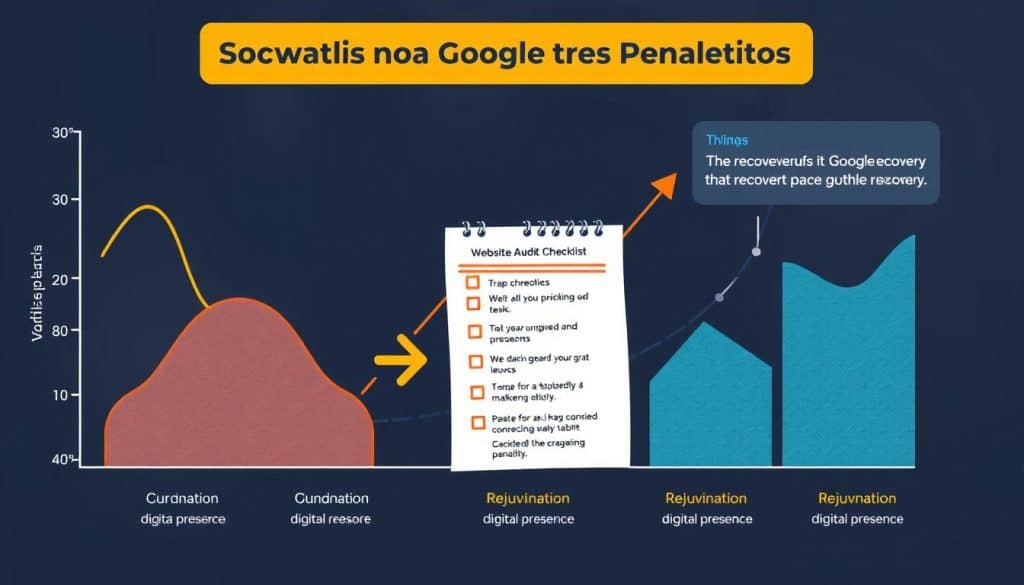
Google penalty recovery is a multi-step process that demands a thorough understanding of the penalty and a well-planned recovery strategy. The process begins with identifying the specific penalty through Google Search Console or correlation with algorithm updates.
Identifying the Specific Penalty
Identifying the specific penalty is crucial, as different penalties require different recovery strategies. Manual actions are visible in Search Console, while algorithmic penalties require detective work to identify the cause.
Creating a Recovery Plan
Creating a comprehensive recovery plan involves auditing your site to identify all instances of the problematic issue. This could involve a backlink audit for link-related penalties or a content audit for content-related issues.
Implementing Corrective Actions
Implementing corrective actions must be thorough and complete. For link-related penalties, this involves removal requests to webmasters and disavowing links that couldn’t be removed. For content-related penalties, it requires improving, consolidating, or removing low-quality pages.
Requesting Reconsideration
For manual actions, submitting a reconsideration request is the final step. This requires a detailed explanation of the issues identified and the specific actions taken to resolve them. Successful reconsideration requests demonstrate both that you’ve fixed the current issues and that you understand how to prevent similar problems in the future.
The recovery process timeline varies significantly – manual penalty recovery may take weeks, while algorithmic penalty recovery can take months as you wait for algorithm refreshes. By following these steps and maintaining a proactive approach to SEO, you can recover from Google penalties and improve your website’s visibility.
Recovering from Specific Google Penalties
Recovering from a Google penalty requires a strategic approach tailored to the specific type of penalty imposed on your site. Google penalties can be categorized into several types, including link penalties, content penalties, and technical penalties, each requiring a unique recovery strategy.
Link Penalty Recovery
Link penalty recovery involves a thorough analysis of your site’s backlink profile to identify and rectify problematic links. We use tools like Google Search Console, Moz, or Ahrefs to identify bad backlinks that violate Google’s guidelines. The process begins with a comprehensive backlink audit, followed by attempts to remove or disavow these links using Google’s disavow tool.
It’s crucial to be cautious when using the disavow tool, as incorrectly disavowing valuable links can further harm your site’s performance. For instance, a comprehensive backlink audit using Ahrefs revealed over 1,000 toxic links pointing to a client’s site, which were subsequently removed or disavowed, leading to a significant recovery in their search rankings.
Content Penalty Recovery
Content penalty recovery focuses on enhancing the quality of your site’s content by addressing issues such as thin or duplicate content. A thorough content audit is essential to identify pages that provide insufficient value to users. These pages should be improved, consolidated, or removed entirely to ensure that your site meets Google’s quality standards.
For example, a content audit on an e-commerce site revealed numerous product pages with thin content, which were subsequently enhanced with detailed product descriptions and high-quality images, resulting in improved search engine rankings.
Technical Penalty Recovery
Technical penalty recovery involves fixing issues related to cloaking, sneaky redirects, hidden text, or structured data violations. These technical issues can manipulate how content appears to users versus search engines, violating Google’s guidelines. Working with experienced developers is often necessary to resolve these complex technical issues.
For instance, a site suffering from cloaking issues worked with developers to rectify the problem by ensuring that user-facing content matched what was presented to search engines, thus resolving the penalty.
| Penalty Type | Recovery Focus | Typical Recovery Timeline |
|---|---|---|
| Link Penalty | Identify and rectify bad backlinks | 1-3 months after Google recrawl |
| Content Penalty | Improve content quality and address duplication | 2-6 months as Google reassesses site quality |
| Technical Penalty | Fix technical issues like cloaking or redirects | 1-2 months after issue resolution and recrawl |
For a detailed guide on the Google penalty recovery process, visit our comprehensive resource on Google Penalty Recovery Process.
By understanding the specific type of Google penalty affecting your site and implementing the appropriate recovery strategies, you can restore your site’s visibility and improve its overall performance.
Preventing Future Google Penalties
The most effective way to deal with Google penalties is to prevent them from happening in the first place. By adopting white hat SEO practices, conducting regular website audits, and staying updated with Google’s guidelines, you can significantly reduce the risk of incurring a penalty.
White Hat SEO Best Practices
White hat SEO focuses on creating high-quality content and earning natural backlinks. This approach not only complies with Google’s guidelines but also enhances your website’s credibility and user experience. Key practices include:
- Creating valuable, user-centric content that satisfies search intent
- Building a natural backlink profile through legitimate outreach and content promotion
- Avoiding manipulative tactics like keyword stuffing and link schemes
Regular Website Audits
Regular technical SEO audits are crucial for identifying potential issues before they trigger penalties. Conducting audits quarterly can help you detect:
- Crawl errors and indexation issues
- Duplicate or thin content
- Problematic links that could be considered spammy
Similarly, content audits should be performed regularly to improve underperforming pages and maintain overall content quality.
Staying Updated with Google’s Guidelines
Google’s guidelines evolve constantly, making it essential to stay informed. Subscribe to the Google Search Central blog and follow official Google representatives on social media to stay updated. Additionally, implementing proper governance and training for your content and marketing teams ensures that everyone understands what practices could put your site at risk.
By following these strategies, you can proactively maintain a compliant website that focuses on user experience and avoids search engine manipulation.
Conclusion
While Google penalties pose significant challenges, a well-planned recovery strategy can not only restore but enhance your website’s search performance. Understanding the specific penalty type and implementing corrective actions are crucial steps. Prevention through white hat SEO practices and regular audits is the best long-term strategy for maintaining search visibility.
Businesses that recover from penalties often emerge stronger, with more sustainable SEO practices and higher-quality websites. By focusing on delivering genuine value to users, websites can align with Google’s objectives. With the right approach, your website can regain its former search visibility and achieve sustainable growth.
FAQ
What are the most common reasons for a website to receive a manual action from search engines?
The most common reasons include unnatural links, thin or duplicate content, keyword stuffing, cloaking, and sneaky redirects, which violate search engine guidelines.
How can I identify if my website has been hit by a search engine penalty?
You can monitor traffic drops in analytics tools, check for manual actions in search console, and use penalty checker tools to identify potential issues.
What is the difference between a manual action and an algorithmic penalty?
A manual action is a penalty imposed by a human reviewer, while an algorithmic penalty is automatically applied by the search engine’s algorithm.
How long does it take to recover from a search engine penalty?
The recovery time varies depending on the type and severity of the penalty, as well as the effectiveness of the corrective actions taken.
What are some best practices to prevent future search engine penalties?
Implementing white-hat SEO techniques, conducting regular website audits, and staying up-to-date with search engine guidelines can help prevent penalties.
Can a website recover from a site-wide penalty?
Yes, but it requires a thorough analysis of the issue, a well-planned recovery strategy, and a successful reconsideration request.
How do I request reconsideration after addressing the issues that led to a penalty?
You can submit a reconsideration request through the search engine’s search console, detailing the actions taken to address the issues and prevent future occurrences.
What role do backlinks play in search engine penalties?
Unnatural or spammy backlinks can lead to link-related penalties, while high-quality backlinks can improve a website’s credibility and ranking.
How often should I conduct a website audit to ensure compliance with search engine guidelines?
Regular audits, ideally quarterly or bi-annually, can help identify and address potential issues before they lead to penalties.