
Are you wondering what makes a web application truly effective? The answer lies in the programming language used to build it.
In today’s digital landscape, selecting the right programming language is crucial for the success, scalability, and maintenance of your web development project. The choice depends on various factors, including project requirements, team expertise, and business objectives.
Understanding the strengths and limitations of various programming languages is key to making an informed decision. As the web development ecosystem evolves, new languages and frameworks emerge, while established ones mature.
Key Takeaways
- Understand the three main categories of web development languages: markup, styling, and programming languages.
- Consider project requirements, team expertise, and business objectives when selecting a language.
- Recognize the importance of scalability and long-term maintenance in your project.
- Familiarize yourself with popular programming languages used in web development.
- Stay updated with the evolving web development ecosystem and emerging technologies.
Understanding Web Development Languages
Understanding web development languages is crucial for crafting sophisticated web applications that meet modern user demands. Web development languages are the foundation upon which websites and web applications are built, defining their structure, design, and functionality.
Defining Web Development Languages
A web development language is a programming or markup language used to create websites and web applications. It encompasses various types, including markup languages like HTML, styling languages like CSS, and programming languages like JavaScript, Python, and PHP. These languages work together to enable user interactions, server-side processing, and the overall user experience.
We explore the fundamental characteristics that define web development languages, distinguishing between different types that form the backbone of modern web applications. The key characteristics include:
- The ability to define the structure and content of web pages
- The capacity to style and layout web pages
- The capability to add interactivity and dynamic effects
- The ability to handle server-side processing and database interactions
The Evolution of Web Programming Languages
The evolution of web programming languages reflects the changing needs of the internet, from simple static pages to complex, interactive applications. Early websites were primarily built using HTML, with the introduction of CSS and JavaScript in the late 1990s and early 2000s bringing styling and interactivity to the web.
Over time, server-side languages like PHP and Python became popular for creating dynamic, database-driven websites. Today, modern frameworks and libraries such as React and Vue.js have further transformed web development, making it faster and more efficient.
Key milestones in this evolution include:
- The introduction of JavaScript in 1995 for client-side scripting
- The rise of server-side languages like PHP and Python in the early 2000s
- The emergence of modern front-end frameworks like React and Vue.js
Key Factors to Consider When Choosing a Web Development Language

Selecting the right web development language is a critical decision that significantly impacts the success of your project. We guide you through the critical evaluation factors that should influence your choice of web development language, ensuring alignment with your business objectives and technical requirements.
Project Requirements and Complexity
The complexity and requirements of your project play a pivotal role in determining the most suitable web development language. Simple informational websites have different language needs compared to complex, data-driven applications with real-time features. According to the 2024 Stack Overflow Developer Survey, JavaScript remains the most commonly used programming language, with 62% of developers reporting regular use, indicating its versatility for various project complexities.
Development Team Expertise
Your development team’s existing expertise significantly impacts language selection. Leveraging their current skills can accelerate development timelines and reduce training costs. For instance, if your team is well-versed in Python, using a Python framework like Django can be highly beneficial. It’s essential to assess your team’s strengths and choose a language that aligns with their expertise.
Scalability and Performance Needs
Scalability requirements should heavily influence your language choice, particularly for applications expected to grow in users, features, or data volume over time. Performance considerations vary by application type—e-commerce platforms, content management systems, and real-time applications each have unique performance profiles that certain languages handle better than others. For example, languages like Java and C# are often preferred for large-scale enterprise applications due to their robustness and scalability.
| Language | Scalability | Performance | Development Speed |
|---|---|---|---|
| JavaScript | High | High | Fast |
| Python | Medium | Medium | Fast |
| Java | High | High | Medium |
As highlighted by industry experts, “The choice of programming language can significantly affect the scalability and performance of web applications.” Understanding the trade-offs between development speed, performance, and maintainability helps you make a balanced decision that serves both immediate and future needs.
Front-End vs. Back-End: Different Languages for Different Purposes
When developing web applications, understanding the distinction between front-end and back-end development is crucial. This distinction is not just about different areas of focus but also about the different languages and tools used in each domain.
Front-end development focuses on creating the user interface and user experience (UI/UX) of a web application. It’s about how the application looks, feels, and interacts with the user.
Front-End Development Languages
Front-end development primarily involves three core technologies: HTML, CSS, and JavaScript. HTML (Hypertext Markup Language) is used for structuring content, CSS (Cascading Style Sheets) for styling and layout, and JavaScript for adding interactivity to web pages.
- HTML provides the basic structure of the site, which is then enhanced by CSS for visual styling.
- JavaScript enables dynamic content and interactive elements, enhancing the user experience.
Modern front-end development often involves frameworks and libraries like React, Angular, and Vue.js, which simplify the development process and improve application performance.
Back-End Development Languages
Back-end development, on the other hand, involves server-side logic, database integration, and API connectivity. It’s about how the application works, its business logic, and how it manages data.
| Language | Use Cases | Notable Frameworks |
|---|---|---|
| Python | Data analysis, machine learning, web development | Django, Flask |
| Java | Enterprise-level applications, Android apps | Spring, Hibernate |
| Ruby | Web development, scripting | Ruby on Rails |
Back-end languages like Python, Java, and Ruby are chosen based on the project’s requirements, such as scalability, performance, and the need for specific functionalities.
JavaScript: The Universal Language for Web Applications
As the only language natively supported by all web browsers, JavaScript is indispensable for front-end development and is gaining traction for full-stack applications. Its versatility and the extensive ecosystem of frameworks and libraries make it a preferred choice for building modern web applications.
Key Features and Capabilities
JavaScript’s event-driven, non-blocking architecture makes it particularly well-suited for real-time applications, such as chat platforms and live dashboards. The introduction of Node.js has expanded JavaScript’s capabilities to server-side development, allowing developers to use a single language throughout the entire application stack.
Advantages of JavaScript for Web Applications
JavaScript offers several advantages for web application development. Its ubiquity across all web browsers ensures that applications built with JavaScript can run seamlessly across different platforms. Additionally, the extensive ecosystem of frameworks and libraries, including React, Angular, and Vue.js, provides developers with powerful tools to build complex applications efficiently.
The asynchronous programming model of JavaScript, while powerful, can create complexity in code structure and debugging. However, mastering concepts like promises and async/await can help mitigate these challenges.
Limitations and Challenges
Despite its advantages, JavaScript faces challenges such as browser compatibility issues and security vulnerabilities if not properly implemented. Moreover, JavaScript’s performance can be a limitation for computation-heavy tasks. However, the emergence of TypeScript as a superset of JavaScript has addressed some of these limitations by adding static typing and other features.
Popular JavaScript Frameworks
Some of the most popular JavaScript frameworks include React, Angular, and Vue.js. These frameworks provide developers with the tools and structures needed to build complex web applications efficiently.
Python: Simplicity and Versatility in Web Development

With its elegant syntax and vast ecosystem, Python has emerged as a preferred choice for web application development. We explore how Python’s simplicity and versatility make it an ideal language for building robust web applications.
Python’s simplicity is one of its most significant advantages. Its clear syntax makes it easy for developers to learn and use, reducing the time and effort required to build web applications. Additionally, Python’s “batteries included” philosophy means it comes with a comprehensive standard library that handles many common programming tasks, minimizing the need for external dependencies.
Key Features and Capabilities
Python’s key features include its readability, versatility, and extensive libraries. These features make Python suitable for a wide range of web development tasks, from building simple websites to complex data-driven applications. Python’s syntax prioritizes code readability, which enhances maintainability and reduces long-term support costs.
Advantages of Python for Web Applications
Python offers several advantages for web application development. Its rapid development capabilities allow developers to quickly build and test web applications. Python’s extensive libraries and frameworks, such as Django and Flask, provide the necessary tools to build scalable and secure web applications. Moreover, Python’s strong community support and extensive documentation make it easier to find solutions to common problems.
Furthermore, Python’s versatility extends beyond web development to data science, machine learning, and automation, making it a valuable skill for developers working on applications that combine these disciplines. The language’s integration capabilities with C/C++ also allow for optimizing performance-critical components when necessary.
Limitations and Challenges
While Python offers many benefits, it also has some limitations. Its interpreted nature can impact performance compared to compiled languages, potentially affecting high-traffic sites. Additionally, Python’s Global Interpreter Lock (GIL) can affect multi-threaded performance. However, these challenges can be mitigated with proper optimization techniques and the use of performance-critical components in C/C++.
Popular Python Frameworks
Popular web frameworks like Django and Flask offer different approaches to web development. Django provides a comprehensive, batteries-included solution, while Flask offers a lightweight, flexible alternative. These frameworks have been instrumental in Python’s popularity for web development, allowing developers to build web applications efficiently.
PHP: The Backbone of Dynamic Websites
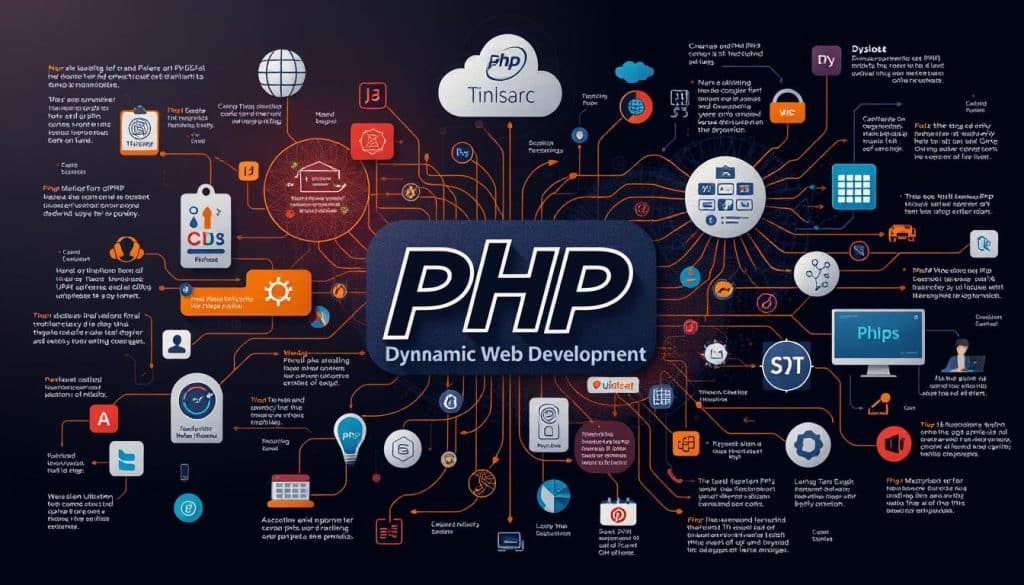
PHP is a server-side scripting language that has been pivotal in web development since its creation in 1994 by Rasmus Lerdorf. It is widely used for developing dynamic websites and web applications due to its ability to interact with databases and process form submissions seamlessly.
Key Features and Capabilities
PHP’s server-side scripting capabilities allow developers to create dynamic web pages that can interact with databases and process form data. Its deep integration with HTML enables a seamless workflow for generating dynamic content.
PHP’s extensive library includes functions for common web development tasks such as database operations, file handling, and form processing, which accelerates development.
Advantages of PHP for Web Applications
One of PHP’s significant advantages is its widespread adoption, ensuring excellent hosting support at competitive prices. This makes PHP accessible for projects of all sizes.
Modern PHP frameworks like Laravel, Symfony, and CodeIgniter have introduced MVC architecture and other advanced programming patterns, transforming PHP development.
Limitations and Challenges
Despite its advantages, PHP faces criticism for inconsistent function naming conventions and potential security vulnerabilities. However, each major release has addressed these concerns, evolving PHP significantly.
Performance optimizations, including just-in-time compilation in PHP 8, have significantly improved execution speed, mitigating some of the historical performance concerns.
Popular PHP Frameworks
Frameworks like Laravel, Symfony, and CodeIgniter are popular among developers due to their ability to simplify complex tasks and improve development efficiency.
For instance, boosting your online presence with WordPress webpage can be achieved using PHP and its frameworks.
Java and C#: Enterprise-Level Web Application Development

Java and C# have emerged as leading choices for developing complex web applications, especially in sectors that demand high security and scalability. Both languages are renowned for their ability to support the development of robust, enterprise-level web applications.
Key Features and Capabilities
Java and C# offer a range of features that make them suitable for enterprise web development. Java’s platform independence through the Java Virtual Machine (JVM) allows developers to write once and run anywhere, making it a versatile choice. C#, on the other hand, is deeply integrated with Microsoft’s ecosystem, providing seamless integration with other Microsoft technologies.
Both languages support object-oriented programming paradigms and have comprehensive standard libraries that facilitate the development of complex web applications. For instance, Java’s Spring framework and C#’s ASP.NET framework provide robust solutions for building enterprise-level web applications.
Advantages for Large-Scale Applications
The use of Java and C# in enterprise web development offers several advantages. Their strong typing and object-oriented programming capabilities ensure that applications are robust and maintainable. Additionally, both languages have extensive libraries and frameworks that simplify development.
For example, Java’s Spring framework simplifies the development process by providing a comprehensive solution for security, dependency injection, and database access. Similarly, C#’s ASP.NET framework offers a robust environment for building dynamic web applications.
Limitations and Challenges
Despite their advantages, Java and C# also present some challenges. The learning curve for both languages can be steep, particularly for developers without prior experience in statically-typed languages. Moreover, the performance characteristics of these languages, such as memory management and startup times, can impact web application deployment and scaling.
However, the benefits of using Java and C# often outweigh these challenges, especially in large-scale enterprise environments where reliability and scalability are paramount.
Popular Frameworks and Tools
Several frameworks and tools are available for Java and C# that simplify enterprise web development. For Java, the Spring framework is highly popular, while C# developers often use ASP.NET for building dynamic web applications.
Emerging Languages: Ruby, Go, and TypeScript

In the ever-evolving world of web development, emerging languages such as Ruby, Go, and TypeScript are redefining the way we build web applications. These languages have gained popularity due to their unique features and capabilities that address specific pain points in the development process.
Ruby and Ruby on Rails
Ruby is a programming language known for its simple and flexible syntax, created by Yukihiro Matsumoto in 1995. It is widely used for web development, especially with the Ruby on Rails framework, which follows the Convention over Configuration (CoC) and Don’t Repeat Yourself (DRY) principles. This makes development faster and more efficient, allowing many startups and businesses to build scalable web applications.
Ruby on Rails has revolutionized web development with its “convention over configuration” philosophy and integrated testing tools, enabling rapid application development with less boilerplate code.
Go (Golang) for Web Applications
Go, or Golang, is a programming language created by Robert Griesemer, Rob Pike, and Ken Thompson at Google in 2009. It was designed for fast execution, simplicity, and scalability, making it ideal for server-side applications, APIs, and cloud-based systems due to its built-in concurrency features.
Go’s simplicity and performance characteristics make it particularly well-suited for microservices architectures, APIs, and high-throughput web services where performance is critical.
TypeScript: Enhanced JavaScript
TypeScript is a programming language that extends JavaScript by adding static typing. Created by Microsoft in 2012, it improves JavaScript’s scalability and maintainability for large projects. TypeScript helps developers catch errors early and write more structured code, making it commonly used with Angular, React, and Vue.js for front-end web development.
TypeScript has become the language of choice for large-scale JavaScript applications, particularly in enterprise environments where code maintainability and team collaboration are priorities.
When to Choose These Languages
Each of these languages occupies a specific niche in the web development ecosystem—Ruby excels in rapid development, Go in performance-critical applications, and TypeScript in large-scale JavaScript projects. Understanding when to choose these emerging languages over more established options requires evaluating your specific project requirements, team expertise, and long-term maintenance considerations.
Best Language for Web Application: Matching Languages to Project Types
The quest for the best web development language is often misguided, as the most suitable language depends on the type of web application being developed. Different projects have different requirements, and the choice of language should be guided by these needs.
E-commerce and Content Management Systems
For e-commerce platforms and content management systems, languages with strong database integration and template processing are preferred. PHP with frameworks like Laravel or Symfony and Python with Django are excellent choices due to their ability to handle complex database operations and template rendering efficiently.
Real-Time Applications and Social Platforms
Real-time applications and social platforms require languages that can efficiently handle concurrent connections and websocket implementations. JavaScript with Node.js and Go excel in these areas due to their non-blocking I/O models, making them well-suited for applications that demand real-time updates and high concurrency.
Data-Intensive Applications
Data-intensive applications with complex analysis requirements often benefit from languages with extensive data science ecosystems. Python is particularly strong in this area due to its rich libraries and frameworks for data analysis and machine learning. For applications requiring real-time data processing, Java or Go might be more suitable due to their performance capabilities.
Enterprise Solutions
Enterprise solutions typically prioritize security, scalability, and long-term support. Java and C# are particularly well-suited for these applications due to their strong typing, comprehensive frameworks, and enterprise-focused features, making them ideal for large-scale business solutions.
Ultimately, the choice of language should be influenced by the specific needs of the project, including the type of application, performance requirements, and the expertise of the development team. By matching the language to the project type, developers can ensure that their web application is built on a robust and scalable foundation.
Future Trends in Web Development Languages
Future trends in web development languages are being shaped by advancements in areas such as artificial intelligence, machine learning, and serverless architectures. As we move forward, it’s crucial to understand the emerging technologies that will influence the choice of programming languages for web applications.
Emerging Technologies and Their Impact
The rise of WebAssembly is enabling high-performance code from languages like Rust and C++ to run in browsers, potentially changing the landscape of client-side development beyond JavaScript’s current dominance. Additionally, static typing is gaining popularity, with TypeScript’s growth and similar typing systems appearing in Python, PHP, and other traditionally dynamic languages. Serverless architectures and edge computing are also influencing language choices, favoring languages with fast startup times and efficient resource utilization.
| Technology | Impact on Web Development | Benefit |
|---|---|---|
| WebAssembly | Enables high-performance code in browsers | Beyond JavaScript’s dominance |
| Static Typing | Gaining popularity across ecosystems | Improved code maintainability |
| Serverless Architectures | Favors languages with fast startup times | Efficient resource utilization |
Preparing for the Future of Web Development
To stay ahead, developers must focus on continuous learning and fundamental programming concepts rather than specific syntax. This adaptability is key to thriving in evolving language ecosystems. Moreover, community trends and corporate backing significantly influence language adoption and longevity, making them important factors to consider when investing in a language for long-term projects.
Conclusion
As we’ve explored the vast landscape of web development languages, it’s clear that the best choice isn’t a one-size-fits-all solution. The ideal programming language for your web application depends on a combination of factors including project requirements, team expertise, and long-term objectives. We’ve seen how JavaScript remains the universal language of the web, offering flexibility for both front-end and back-end development. Meanwhile, languages like Python and PHP excel in specific areas such as rapid development and content management.
When choosing a web development language, consider not just the language’s popularity, but also its community support, available talent, and long-term maintenance needs. At Cres, we understand the importance of selecting the right technology stack for your business needs. Emerging languages like Ruby, Go, and TypeScript offer compelling advantages for specific use cases. Ultimately, investing in good architecture, testing practices, and documentation will have a greater impact on your project’s success than the language itself.
FAQ
What is the most versatile programming language for web development?
JavaScript is widely considered the most versatile programming language for web development, as it can be used for both front-end and back-end development, and is supported by most frameworks and libraries.
How do I choose the right web development language for my project?
To choose the right web development language, consider factors such as project requirements, complexity, development team expertise, scalability, and performance needs.
What are the key differences between front-end and back-end development languages?
Front-end development languages, such as JavaScript, HTML/CSS, and TypeScript, focus on client-side development, while back-end development languages, such as Python, PHP, and Java, handle server-side logic, database integration, and API connectivity.
Is Python a good choice for web application development?
Yes, Python is a popular and versatile choice for web application development, known for its simplicity, flexibility, and extensive libraries, making it suitable for a wide range of applications, from simple websites to complex data-driven applications.
What are the advantages of using JavaScript frameworks like React and Angular?
JavaScript frameworks like React and Angular offer numerous advantages, including improved code organization, enhanced performance, and simplified maintenance, making it easier to build complex and scalable web applications.
How do emerging languages like Ruby, Go, and TypeScript compare to established languages?
Emerging languages like Ruby, Go, and TypeScript offer unique strengths and advantages, such as simplicity, concurrency, and type safety, making them attractive alternatives to established languages for specific use cases and project requirements.
What are the most suitable programming languages for e-commerce and content management systems?
For e-commerce and content management systems, popular choices include PHP, JavaScript, and Python, which offer a range of frameworks and libraries, such as Magento, WooCommerce, and Django, to support complex online stores and content-rich websites.
How do I prepare for the future of web development?
To prepare for the future of web development, stay up-to-date with emerging technologies, such as serverless computing, progressive web apps, and artificial intelligence, and be prepared to adapt to changing project requirements and industry trends.