

Are you ready to unlock the full potential of voice-activated searches and drive revenue growth for your business?
With over 50% of internet searches now being voice-activated, and over 1 billion voice searches conducted monthly, optimizing for voice search is no longer a nicety, but a necessity for businesses in Qatar and globally.
As voice search continues to reshape the digital landscape, businesses that fail to adapt risk being left behind. We will explore how effective voice search strategies can significantly boost your ROI by capturing the growing audience of voice search users.
Key Takeaways
- Discover how voice search optimization can drive revenue growth for your business.
- Learn how to optimize your digital presence for voice search users.
- Understand the importance of voice search in today’s digital marketing landscape.
- Find out how to stay ahead of competitors with effective voice search strategies.
- Explore the latest statistics and trends in voice search usage.
The Voice Search Revolution: Why It Matters
The rise of voice search is transforming the digital landscape, presenting both opportunities and challenges for businesses worldwide. As we witness an unprecedented shift in how consumers interact with search engines, it’s clear that voice search adoption rates are accelerating faster than most digital marketing experts anticipated.

Current Voice Search Statistics
Recent statistics paint a compelling picture of the growing importance of voice search. About 20% of mobile searches are now done using voice, and more than half of people (58%) use voice search to learn about local businesses. Furthermore, 72% of people using voice search have made it part of their daily routines. These numbers indicate a significant shift in consumer behavior, with voice search becoming an integral part of daily life.
| Statistic | Percentage |
|---|---|
| U.S. households owning smart speakers | 55% |
| Mobile searches done using voice | 20% |
| People using voice search for local businesses | 58% |
The Growing Impact on Business Revenue
The financial implications of voice search are substantial. Analysts expect the voice assistant market to add more than 20 million users by 2028 and reach a value of nearly $32 billion by 2033. For businesses in Qatar and the Middle East, this revolution presents both challenges and opportunities. Companies that fail to optimize for voice search risk losing substantial visibility and revenue as consumer behavior continues to evolve toward voice-first interactions.
To stay competitive, businesses must adapt their digital marketing approaches to capture this growing segment. This involves understanding voice search technology and its impact on SEO strategies. By doing so, companies can ensure they remain visible and relevant in a rapidly changing digital landscape.
Understanding Voice Search Technology
Voice search technology is revolutionizing the way we interact with digital devices, making it essential to understand its underlying mechanics. As we delve into the world of voice search, we find that it’s powered by sophisticated technologies like artificial intelligence (AI) and natural language processing (NLP). These technologies enable voice assistants to interpret and respond to spoken queries effectively.
How Voice Search Works
Voice search works by leveraging three key components: speech recognition, natural language understanding, and information retrieval. When a user speaks a query, the speech recognition component converts the spoken words into text. The natural language understanding component then interprets the meaning of the text, and the information retrieval component fetches the relevant answers from the vast repository of online content.

Google vs. Siri vs. Alexa: Key Differences
The major voice assistants – Google Assistant, Siri, and Alexa – differ in their underlying technology and search engines. Google Assistant relies on Google’s powerful search capabilities, while Siri uses a combination of Google and other search engines like Yahoo and Bing. Alexa, on the other hand, draws its information primarily from Bing. Understanding these differences is crucial for businesses aiming to optimize their content for voice search.
Voice Search in Qatar and the Middle East
The voice search landscape in Qatar and the Middle East is evolving rapidly, with improving Arabic language support across major voice assistant platforms. This presents unique opportunities for businesses targeting the Qatari market. To capitalize on this trend, businesses must develop effective voice search optimization strategies that cater to the local language and cultural nuances.
Voice Search vs. Text Search: Critical Differences
Voice search and text search differ in several critical ways, impacting how businesses approach their SEO strategies. The main differences lie in how users interact with search engines, the complexity of their queries, and the context in which they search.
Conversational Language Patterns
Voice searches typically use conversational language patterns that mimic natural human speech. Users ask complete questions rather than typing fragmented keyword phrases. For instance, a user might type “best coffee shop” but say “what’s the best coffee shop near me that’s open now?” when using voice search. This shift towards more natural language affects how businesses should optimize their content for voice search.
Query Length and Complexity
The data shows that voice search queries are substantially longer than text searches, averaging 29 words compared to just 1-3 words for typical text searches. This increased length and complexity mean that businesses need to focus on long-tail keywords and phrases that reflect how people naturally speak.
| Search Type | Average Query Length | Query Complexity |
|---|---|---|
| Voice Search | 29 words | High |
| Text Search | 1-3 words | Low |
User Intent and Context
User intent becomes more transparent in voice search as people naturally express their needs more explicitly, using question words like “how,” “what,” “where,” and “why.” Context also plays a crucial role, with devices often using location data, search history, and user preferences to deliver more personalized results. As
“The future of search is not just about keywords, but about understanding the intent and context behind the query.”
, highlighting the importance of adapting SEO strategies to accommodate these differences.
Understanding these critical differences allows businesses to create content that aligns with how their customers actually speak, rather than how they type, resulting in higher visibility and conversion rates.
Essential Voice Search Optimization Strategies
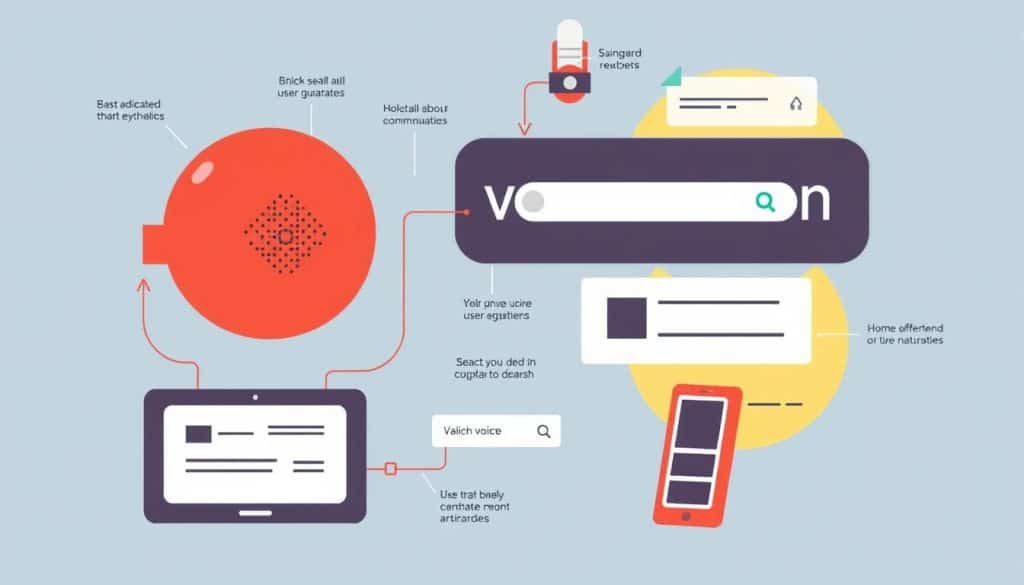
To dominate voice search, businesses must adopt a multi-faceted approach that incorporates conversational keywords, structured data, and optimized website performance. This comprehensive strategy is crucial for improving visibility and relevance in voice search results.
Mastering Conversational Keywords
Conversational keywords are the foundation of voice search success. Long-tail keywords that reflect natural speech patterns are essential for matching how customers actually speak. For instance, instead of targeting “best Italian restaurant NYC,” focus on phrases like “What’s the best Italian restaurant in New York City?” or “Where can I find a great Italian restaurant in NYC?”
To identify the right conversational keywords, analyze your customers’ queries and incorporate question phrases like “what,” “where,” and “how” into your content.
Optimizing for Featured Snippets
Featured snippets, also known as “position zero,” are critical for voice search, as they provide direct answers for virtual assistants. To improve your chances of getting a featured snippet, offer clear and concise answers to common questions in your field. Use bullet points, numbered lists, or short paragraphs (40-50 words) for easy reading.
For more information on optimizing for featured snippets, you can refer to our comprehensive guide on how to do SEO for a website.
Implementing Structured Data
Structured data, or schema markup, is code that helps search engines understand your website better. This extra information can boost your chances of ranking for voice searches and appearing in special search results. By implementing structured data, you can provide search engines with explicit information about your content, significantly increasing the likelihood of appearing in voice search results.
Improving Website Speed and Performance
Website speed and performance are non-negotiable factors in voice search rankings. To improve your site’s loading times, focus on technical improvements such as optimizing images, minifying code, and leveraging browser caching. A fast and responsive website is essential for providing a good user experience and improving your search engine rankings.
Creating Voice-Friendly Content
To optimize for voice search, businesses must adapt their content strategy to match the conversational tone of voice queries. This involves creating content that is clear, concise, and easy to understand.
We have identified key strategies for developing voice-friendly content that not only enhances user experience but also improves search engine rankings.
Question-Based Content Structure
Organizing content around specific questions that customers are asking creates immediate relevance for voice search algorithms. This question-based structure aligns perfectly with voice search behavior, making it easier for users to find the information they need.
By using a conversational tone and natural language patterns, businesses can make their content more accessible and user-friendly.
Optimal Answer Length and Format
Our analysis of voice search results reveals that the optimal answer length averages 29 words, striking a balance between comprehensiveness and conciseness. Keeping answers concise and to the point is crucial for voice search success.

Using simple language and short sentences, businesses can create content that is easily digestible by both users and voice assistants.
FAQ Pages and Voice Search Success
FAQ pages have emerged as powerful voice search assets due to their question-and-answer format, which naturally matches the query-response pattern of voice interactions. By creating comprehensive FAQ pages, businesses can improve their visibility in voice search results.
To maximize the effectiveness of FAQ pages, businesses should focus on answering common questions directly and concisely, using clear headings and bullet points to structure the content.
By implementing these strategies, businesses can create voice-friendly content that resonates with their target audience and drives revenue growth.
Local SEO for Voice Search Success
Local SEO is crucial for voice search success, as it directly impacts a business’s visibility in local search results. With a significant portion of voice searches being local, businesses must optimize their online presence to capture this traffic.

Google Business Profile Optimization
Optimizing your Google Business Profile is foundational to local voice search visibility. Ensure your business name, address, phone number (NAP), business categories, and operating hours are accurate and up-to-date. Encourage satisfied customers to leave reviews, as these can significantly impact your visibility in voice search results.
Targeting “Near Me” Searches
“Near me” searches have seen exponential growth with the adoption of voice search. To improve visibility for these searches, consider factors like distance, relevance, and prominence. Create content and pages for each location, and integrate Google Maps into your website to enhance local search visibility.
Local Content Creation Strategies
Effective local content creation involves developing neighborhood-specific pages, location-based FAQs, and content referencing local landmarks. This strategy not only improves your voice search visibility but also enhances your overall local SEO. For multi-location businesses, creating dedicated content for each location can dramatically improve voice search success.
Technical Factors Affecting Voice Search Performance
To improve voice search visibility, it’s essential to address the technical aspects that impact its performance. Voice search is becoming increasingly popular, and optimizing for it requires a deep understanding of the technical factors at play.
Mobile Optimization Requirements
With over 50% of voice searches occurring on mobile devices, mobile optimization is non-negotiable for voice search success. A responsive design, touch-friendly navigation, and mobile-first content are essential requirements. Ensuring that your website is mobile-friendly is critical, as it directly impacts user experience and search engine rankings.
Page Speed and Voice Search Rankings
Page speed emerges as one of the most influential ranking factors for voice search. Voice results typically load 52% faster than average web pages. To improve page speed, use tools like Google’s PageSpeed Insights or GTmetrix to identify areas for improvement. Techniques such as compressing images, minifying CSS and JavaScript, and leveraging browser caching can significantly enhance page load times.
Domain Authority and Its Impact
Our analysis shows that domain authority plays a surprisingly important role in voice search rankings. The average voice search result comes from domains with an Ahrefs Domain Rating of 77 or higher.
“Sites with lots of links pointing to them tend to rank more often in regular searches, and the same applies to voice search.”
Building high-quality backlinks is crucial for improving domain authority and, subsequently, voice search visibility.

Measuring Voice Search ROI and Future Trends
As voice search continues to reshape the digital landscape, understanding its ROI is crucial for businesses to stay ahead. We’ve developed a comprehensive framework for measuring voice search ROI that goes beyond traditional metrics to capture the unique value of voice-driven traffic and conversions. This involves using specialized approaches to attribution modeling, such as tracking voice search traffic through custom UTM parameters and voice-specific conversion paths.
Key trends shaping the future of voice search include the rise of voice commerce (v-commerce), with voice shopping expected to reach $40 billion in annual revenue by 2025. For businesses in Qatar, voice search presents particularly strong growth opportunities as smart device adoption accelerates across the Middle East region. Moreover, multilingual voice search capabilities are improving, making optimization in both English and Arabic increasingly important.
The integration of voice search with other technologies like augmented reality and the Internet of Things will create new optimization challenges and opportunities. To remain competitive, businesses must prepare for these advancements and prioritize privacy considerations, as users demand greater transparency and control over their voice data. By optimizing for voice search and staying ahead of these trends, businesses can drive more traffic to their site and gain a competitive edge in the market.
FAQ
How does voice search technology impact my business revenue?
Voice search technology can significantly influence your business revenue by changing how customers find and interact with your brand online. As more users turn to voice assistants, optimizing for voice search can improve your visibility and drive more conversions.
What are the key differences between voice and text search queries?
Voice search queries tend to be longer and more conversational than text searches, often taking the form of full questions or statements. This shift requires businesses to adapt their SEO strategies to accommodate more natural language patterns.
How can I optimize my website for voice search engines?
To optimize for voice search, focus on using conversational keywords, optimizing for featured snippets, implementing structured data, and improving your website’s speed and performance. These strategies can help your site rank higher in voice search results.
What role does Google Business Profile play in voice search results?
A well-optimized Google Business Profile is crucial for voice search success, particularly for local businesses. It helps your business appear in “near me” searches and provides essential information to users, such as hours, location, and reviews.
How do I measure the ROI of my voice search optimization efforts?
To measure the ROI of your voice search optimization efforts, track key metrics such as website traffic, conversions, and revenue generated from voice search-driven users. Analyzing these metrics will help you refine your strategy and improve your returns.
What is the importance of page speed in voice search rankings?
Page speed is a critical factor in voice search rankings, as faster-loading websites provide a better user experience. Optimizing your site’s speed can improve your search engine rankings and drive more traffic to your site.
How can I create content that is friendly to voice assistants?
To create voice-friendly content, focus on question-based structures, optimal answer lengths, and formats that are easily readable by voice assistants. This will help your content be more discoverable and accessible to users relying on voice search.